

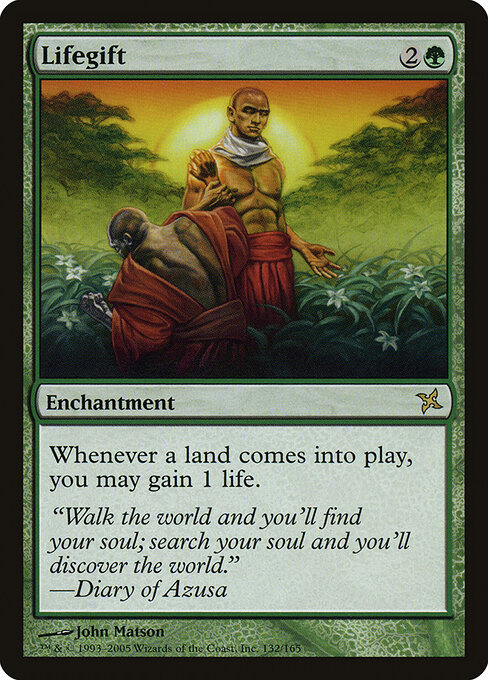
If Betrayers of Kamigawa's green enchantment spent two decades as a Commander sidebar almost never on lists, and if most people hearing *Lifegift* only recall John Matson's art and the line that a land entering may gain you one life, then October 2026's *Kwia Vigorbloom* Lotus trigger inside Reality Fracture rewrote that never-reprinted sheet as another kind of buyout tax. MTGGoldfish's weekly update (published 2026-10-26, covering through Oct 25) casts this buyout as a gain of more than 200%, with asks landing at $56. Wargamer (updated 2026-10-19) tracks the floor from about $7.30 at the start of 2026 to $23.45 through September–October. MTGRocks (2026-10-20) pins the lightly played sold peak after the Kwia reveal at $23.13, and lightly played listings from $45.80 including shipping. The image that runs through this piece is a three-copies-a-day buyout tax. The same-week spike of *Dark Matter Manipulator* at about seventy copies a day makes Lifegift's peak of about three copies a day easier to read.
I lined up the MTGGoldfish weekly, Wargamer's spike write-up, MTGRocks inventory and sold notes, the TCG Strat card page (prices updated around Oct 24), and this article's Scryfall fetch (2026-10-27). Boards disagree by tens of dollars; the direction points at the same fact. This piece cites only public readings I checked. The same-week liquidity contrast is Reality Fracture's *Dark Matter Manipulator*. Goldfish puts its peak near seventy copies a day; Lifegift's peak near three still enough to turn a thin shelf into an ask myth.

1. From shelf to ask: zero reprints and an underopened Kamigawa
The industry default is clean, and therefore lazy.
An old-set rare jumps. The default story almost always stares at percentage, Commander density, and whether same-theme triggers move together. Lifegift's Oracle is one sentence. Whenever a land enters, you may gain 1 life. The artist is still John Matson. The number is still Betrayers of Kamigawa #132. Scryfall at this fetch reads usd 14.69, usd_foil 49.00, eur 7.19. The default therefore almost writes itself. Green-white lifegain got loud; the old enchantment rose with it.
Public material splits that default. Goldfish's weekly says the card sees very little play including Commander, showing mainly in some Kwia Vigorbloom builds. Reprint count is literally zero. No Secret Lairs, no The List, nothing. Betrayers of Kamigawa was underopened; supply was already tiny. Wargamer puts the same zero-reprint line into a price path. About $7.30 at the start of 2026, about $10 after nine months, $23.45 through September–October, roughly 220% from year start. MTGRocks fills in the shelf scene. Near-mint nonfoil sold out on TCGplayer; a single near-mint foil around $150; lightly played listings from $45.80 including shipping; at one stretch the cheapest heavily played under $23, next cheapest about $40. Secrets of Strixhaven and Reality Fracture already drew the shelf down before asks rewrote it as buyout tax.

2. Three a day versus seventy a day: how thin solds print a high ask
Percentage myths fear daily volume.
Goldfish's weekly contrast writes two Reality Fracture-adjacent papers as two liquidities. *Dark Matter Manipulator* peaked near seventy copies a day. Lifegift peaked near three. Three a day was still enough to skyrocket the price. That reading is hard. It asks the reader to split the price jump from how many copies actually moved. Seventy a day is a hot mouth. Three a day is a thin mouth. Asks on a thin mouth can rewrite overnight because almost nothing sits on the shelf to sell.
TCG Strat's card page (prices around 2026-10-24) pulls the market back to a mid layer. Lifegift about $14.69, +27.2% over seven days, +42.1% over thirty. EDHREC rank about #11,442, up 479 in thirty days. Scryfall the same day also sits at 14.69. MTGRocks records lightly played solds after the Kwia reveal. Forty-eight lightly played sales, peak $23.13; lightly played previously about $10.45. Wargamer's $23.45 sits in the same band. Goldfish's buyout narrative at $56, Scryfall or TCG Strat's mid-teens mid layer, and MTGRocks lightly played solds near $23 or asks above $45 sit side by side. The divergence itself is evidence. Thin print, low daily solds, single-digit peak volume already make different boards catch different ask layers.
If a reader only stares at fifty-six, the buyout becomes a full hot mouth. Stack three a day against seventy a day and the scene looks closer to scarcity tax printing. Asks can jump with a buyout. Daily solds rewrite much more slowly.

3. The Lotus rings once: why Kwia needs diversified triggers
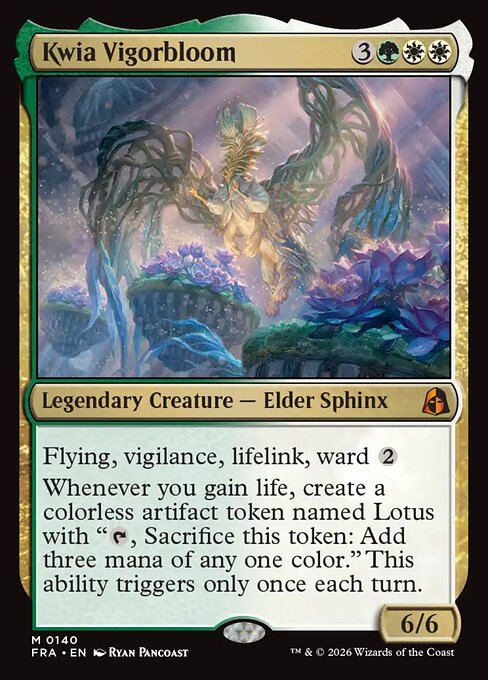
Stare only at how much Lifegift rose and the story narrows to another expensive Kamigawa enchantment. Point the lens at *Kwia Vigorbloom*'s trigger window and the mechanism this buyout tax actually bites becomes visible.
Kwia Vigorbloom is Reality Fracture #140, art by Ryan Pancoast. Cost {3}{G}{W}{W}. Flying, vigilance, lifelink, ward {2}. Whenever you gain life, create a Lotus token (three mana of any color), once each turn. Scryfall at this fetch reads usd 7.99. Wargamer and MTGRocks both write that once-each-turn line as deck pressure. Soul Sisters-style creature-enter lifegain can burn the window before a land enters. Lifegift hangs on landfall and can split the trigger sources. Land in, life gained, Lotus rings. The same table still needs room for Dina, Bilbo, and this year's Secrets of Strixhaven *Blech, Loafing Pest*. Diversified triggers exist so the Lotus rings on the correct once.
List density splits the default word "required." MTGRocks writes Lifegift historically into fewer than 10,000 Commander decks; about 19% of Kwia lists carry it, a bump of roughly 900+ decks. Wargamer writes about 20%. It is not a forced Kwia piece. Soul Warden's same-day contrast sits near $4.19 (Scryfall Modern Masters 2017 #24), also able to feed life, yet on a wholly different supply layer. Blech same day about $0.36. Kwia itself about $7.99. Part price gaps sit here. The trigger window is scarce; the old enchantment's supply is scarcer; ask tax lands on the zero-reprint layer.


4. Tax when reprints equal zero: aggregator split and a still-wobbling mid layer
What this wave rewrites is where a cold Betrayers of Kamigawa enchantment sits on the secondary market.
Before the spoiler, Lifegift could be written as old paper almost never on Commander tables. October's Kwia Lotus pushed about 19–20% list share toward the shelf. Goldfish writes buyout, more than 200%, ask $56. Wargamer writes $7.30 to $23.45. MTGRocks writes lightly played sold peak $23.13, asks from $45, near-mint nonfoil sold out. TCG Strat and Scryfall still park the mid layer near $14.69. Numbers will keep wobbling. Zero reprints, underopened Kamigawa supply, a three-a-day peak, and the same-week seventy-a-day contrast will not vanish with the poster.
The multiplier the secondary market has been printing on asks these days is zero reprints times thin solds. The single-card myth only grabs eyes. Under the eyes sit single-digit daily solds, condition splits, sold-out near-mint nonfoil, and aggregators each catching a different ask layer. Tear the poster and the ledger remains.
A reader who wants one thread can open five pages at once. MTGGoldfish weekly for the buyout narrative, the $56 ask, three a day versus seventy. Wargamer for $7.30 to $23.45 and about 20% Kwia share. MTGRocks for lightly played sold peak $23.13, asks from $45.80, near-mint sold out and foil near $150. TCG Strat and Scryfall for the $14.69 mid layer, seven- and thirty-day moves, and same-day contrasts for Kwia, Soul Warden, Dark Matter Manipulator, and Blech. Numbers will keep wobbling. The 2004 zero-reprint line has already been re-priced by an October Lotus trigger. Whether that price keeps pace with daily solds and counter cash is a separate sum.
Close: secondary-market independence, refusing one percentage line that merges demand with print
Put Lifegift back into Magic's October 2026 secondary floor and it hits a quieter reading habit. People often translate a buyout ask straight into table necessity, and often write a same-week spike as hot-mouth liquidity. When gain boards and mid-layer markets share one sentence that the old card is rising, then pick one so-called true price out of aggregator disagreement, the habit hardens.
Public data gives a concrete counter-example. Goldfish buyout narrative more than 200% to about $56; Wargamer about $7.30 to $23.45 (about 220%); MTGRocks lightly played previously about $10.45, post-reveal sold peak $23.13, asks from $45.80, near-mint nonfoil sold out, foil about $150; Scryfall and TCG Strat mid layer about $14.69 (+27.2% 7d, +42.1% 30d); EDHREC about #11,442, up 479 in 30 days; Kwia list share about 19–20%; historically under 10,000 Commander decks; peak about three copies a day versus Dark Matter Manipulator about seventy; Soul Warden about $4.19, Kwia about $7.99, Blech about $0.36; reprints zero. Concrete, because it forces daily solds, condition asks, and zero-reprint supply into view; the buyout poster is a clue, not a verdict.
Independence can be redefined here. Independence can mean insisting on split books inside the same October spike. Buyout tax on a thin shelf is one book; mid-layer market and lightly played solds are another. Kwia's once-per-turn Lotus pressure, and aggregators each catching a different ask layer, also need separate lines. When building a watch list, write first which papers still peak at single-digit daily solds, which reprint records are zero, which near-mint nonfoils have sold out, then decide whether the seven characters of a fifty-six-dollar ask deserve cash.
Executable prompts stay short.
- Reading a buyout narrative, first split ask print from daily solds and completed sales; if you cannot restate both columns, treat fifty-six as noise.
- Open EDHREC and Kwia share; about 19–20% and historically under 10,000 decks cannot carry a whole-table necessity default.
- Keep three a day and seventy a day on two tables; Dark Matter Manipulator's hot mouth does not prove Lifegift's ask has been booked by daily solds.
- Treat aggregator disagreement (Goldfish about $56 versus Strat/Scryfall about $14.69 versus MTGRocks solds near $23 or asks above $45) as thin-market grammar first, as a trade signal second.
- Zero reprints, sold-out near-mint nonfoil, and a once-per-turn Lotus window sit closer to this Kamigawa enchantment's real thickness than any single market number.
October's secondary market is still writing cold old enchantments as buyout tax, and Betrayers of Kamigawa's thin supply has not tightened the liquidity clock. For anyone watching Lifegift, the face is still John Matson's 2004 painting. The secondary market suddenly willing to write zero reprints as a $56 ask in the same week still leaves daily solds near three and the Scryfall mid layer at 14.69. Someone has shown that buyout tax can grow into myth on a thin shelf, while three copies a day and seventy copies a day already belong to two different books.

Sources and further reading
MTGGoldfish Weekly Update Oct 25 (published 2026-10-26)
Wargamer · Lifegift price spike (updated 2026-10-19)
MTGRocks · MTG Lifegift price spike (2026-10-20)
Scryfall Kwia Vigorbloom FRA#140