
If the default indie myth is “bet years on one ultimate game, then be discovered or forgotten in launch week,” the August 2026 postmortem ByerN (Steam developer page ByerNGames) wrote for r/gamedev and r/IndieDev almost publicly rewrites that script: three years, three finished games, two shipped node titles totaling more than $150,000 in Steam net revenue, and a third—Node Crown—content-complete, waiting to ship after Steam Next Fest. The wager is not a one-shot masterpiece. It is a node production line that can be reused, bundled, and backported.
That can sound like “franchising for money.” What carries weight is his willingness to open the ledger—Node Farm lifetime net revenue $102,222 and 16,504 units; Node Math net $60,535 and 12,661 units—and honestly mark that the still-unreleased third game sat at roughly 676 wishlists. The through-image of this piece is “connection” itself: in a node game every edge rewrites logistics and yield; across his three years, connection happens between titles—code backports, bundle sales, festival calendars, community translations, and one accidental influencer pickup that rescued a second game he nearly abandoned.
I. Default Logic: Indie Equals One Masterpiece, Three Years Equals One Bet
The industry default is clean, and therefore seductive.
Once an after-hours developer decides to “seriously make a Steam game,” the surrounding narrative usually collapses into the same menu: pick a big enough vision, finish one complete product, stack wishlists, show up at some Next Fest, then let launch week decide. Failure stories are blamed on “overscope on the first title”; success stories are mythologized as “years sharpening one blade.” ByerN supplies his own counter-example: he never finished his first Steam game, TAnima, and the postmortem is blunt—do not overscope your first game; come back when you have more experience.
What the node trilogy smashes is the arithmetic that “three years must equal one game.” He pins his hours to an unromantic range: about two to five hours on a weekday after work. The stack is exotic—open-source Java framework libGDX plus Scala—yet hammered into a reusable base across thirty-plus small games and prototypes. Self-publishing is not a romance slogan; it is the full pipeline he chose to learn: market research, development decisions, feedback, promotion, and post-release community work. Reading HTMAG is one thing; keeping every success and failure on your own books is another.
This is where default myth and production ethics diverge. The myth asks: where is your one masterpiece. Connection-style indie asks: can you ship three finished games in three years, and make each one’s code, festivals, and players into sockets for the next connection.
II. First Connection: A Cozy Shell Smuggles in Factory Logic; Visuals and Wishlists Win First
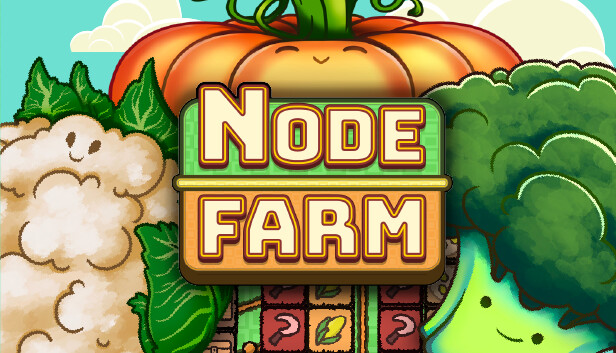
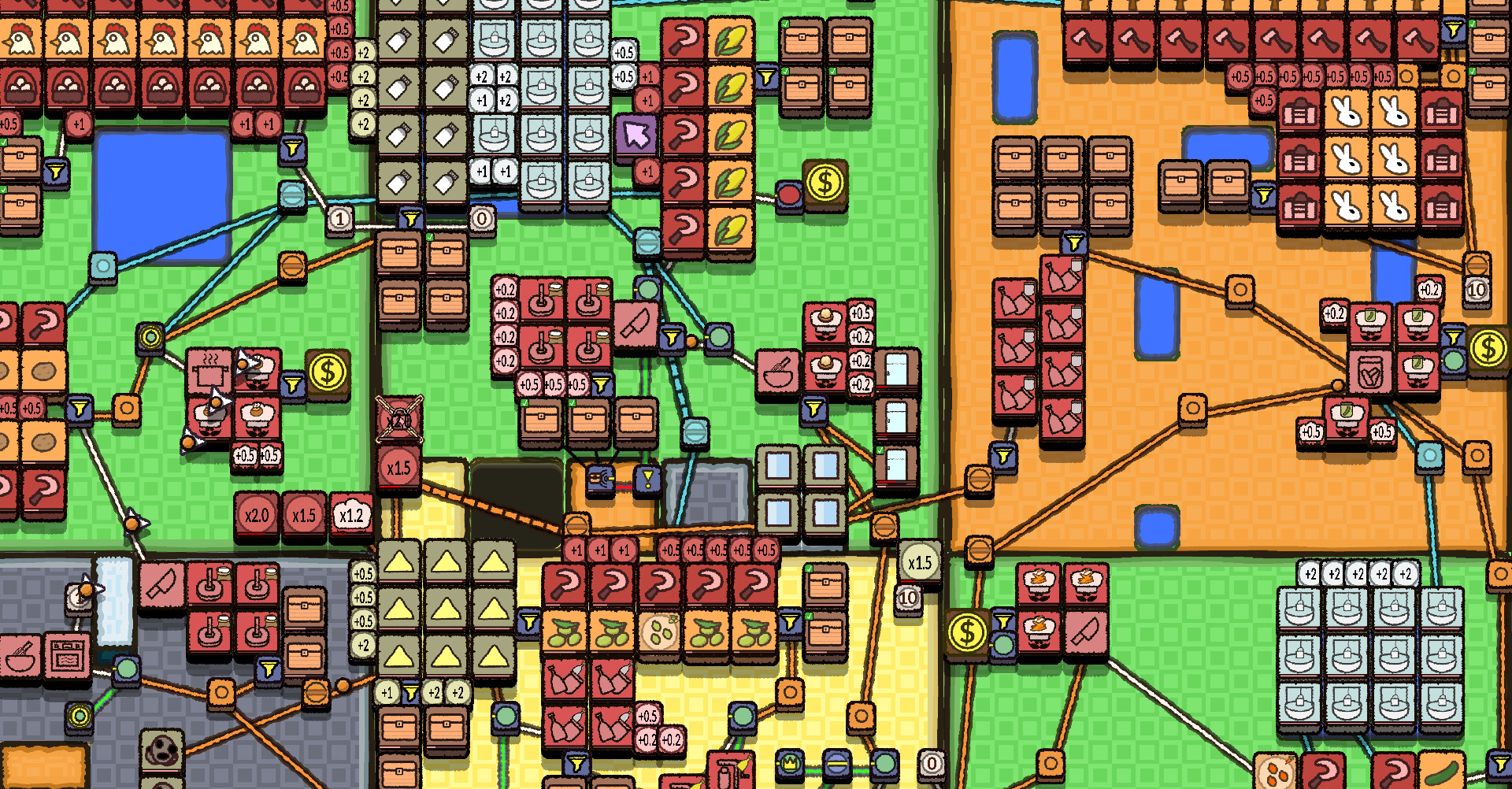
Node Farm took about twelve months, launched 19 November 2024, and settled at $12 with regional pricing (it started at $15 without regional adjustments). It is a factory/incremental game: build a farm with nodes, process ingredients, sell into a shifting market, buy more nodes—logistics and automation at the core. ByerN’s personal goal was explicit: a simpler, cozier factory game that could be a first step for cozy players and still fun for factory fans. The postmortem admits that part did not work as hoped; cozy players still found it hard, and core mechanics could not change without a rewrite. What he learned was still enough to feed the later titles.
The “good” side is almost entirely marketability. Colorful, cozy looks catch the eye; the trailer explains the game at a glance; the theme hit many Steam festivals that year; influencers picked it up before he emailed them; Reddit ads and milestone posts (store page, playtests, demo, Next Fest, full release, major updates) were the main channel; professional localization covered a large Chinese audience (with quality issues—feedback that “node” became “knot” in some languages); Discord was mandatory—he had adminned a Polish indie server and turned public todos, playtest recruiting, and reply-to-feedback review flips into process. Wishlists at launch: 31,853; later 28,574. Lifetime net revenue six figures; a long tail still earns on discounts and festivals.
The “bad” side is equally concrete: UI/controls/mechanics not intuitive enough; demo bugs once froze an influencer who found the game in the wild; balancing was a nightmare; his own TikTok/short videos barely worked. The pricing lesson becomes an executable note: after-release price cuts are worse than getting regional pricing right up front; if you accidentally overpriced, deeper discounts beat a permanent cut. Through all of it runs “marketability you can show in a gif/short”—pick the right genre and trailer, festivals, influencers, and ads get easier together; pick wrong and every channel gets harder together.
III. Second Connection: The Franchise Is Proven, Translation-Free Hits a Wall, Bundles Weld Both Titles
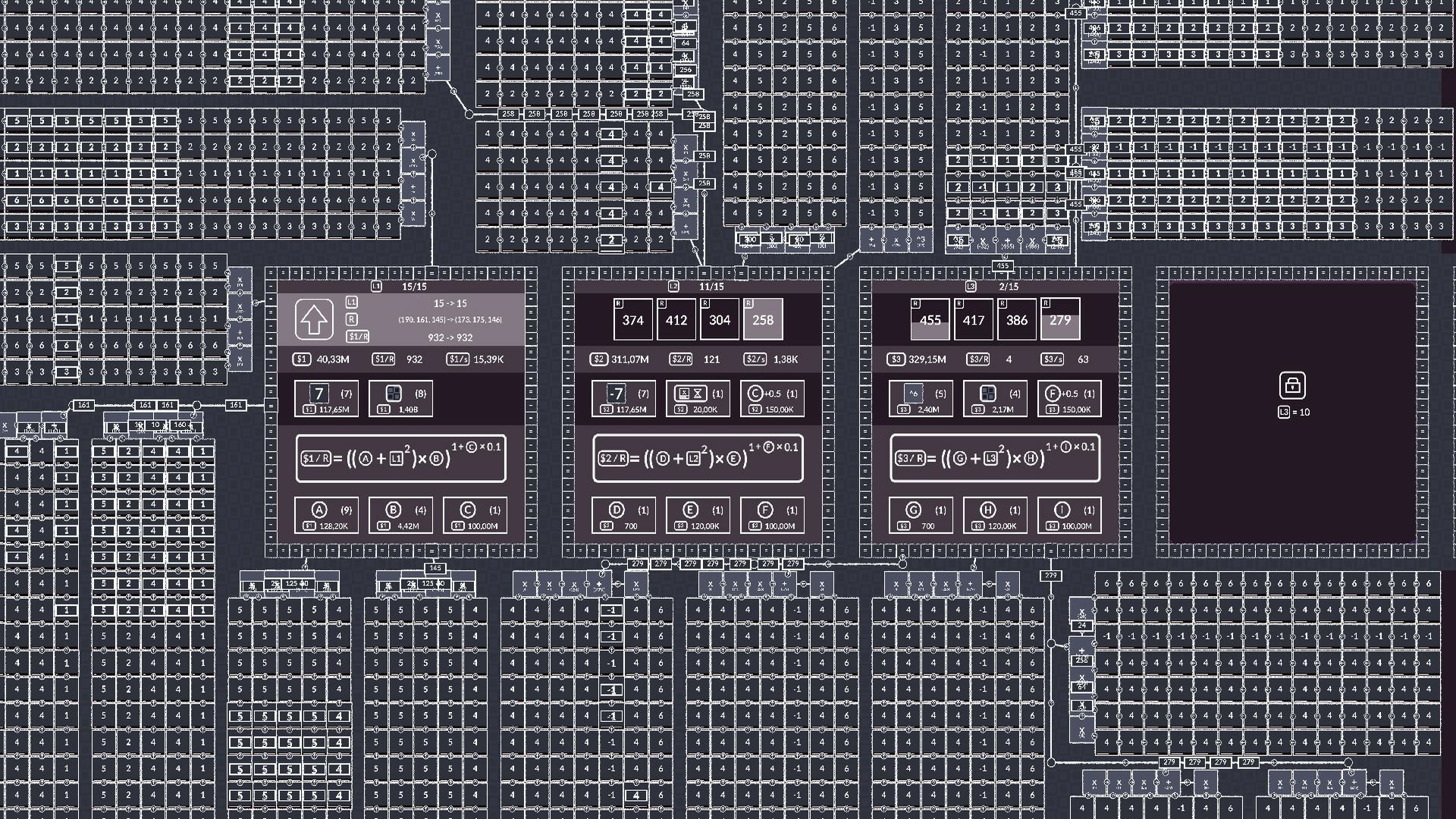
Node Math took about eight months, launched 27 October 2025 at $7 with regional pricing. Still a node factory/incremental, but themed around crafting numbers, making money, buying more stuff—personal goals: prove the “franchise” idea with different theme and mechanics, and lean harder into pure incremental math. Another goal was bolder: a game that skips traditional translations and can be played without text (Steam suggests marking all languages on the store page in such cases). Math looked like the ideal candidate. He was wrong.
Translation-free design punched through the UX before Next Fest. The postmortem is hard: making a translation-free factory game was a UI/UX problem his skills could not carry. After Next Fest he added optional translations and opened a community translation repo on Discord—players can now play with or without text. Wishlists at launch only 12,380, then grew to 18,208 and still climbing; net revenue $60,535, units 12,661. Bundling with Node Farm proved the franchise bet: most players buy both, lifting first-title sales. Code reuse shortened the schedule; features on the shared codebase backport to Node Farm—the most material layer of “connection”: fix once, benefit twice.
The more dramatic turn came at the worst wishlist trough. ByerN nearly dropped Node Math to chase the next game; what changed it was one influencer picking it up by accident, triggering Discord influx and more videos. His judgment stays careful: sometimes the game is not bad—it simply has not reached people who would like it—an exception, not a rule. Tiny Teams worked better for him than Next Fest; Discord is written as a “stop reading and go set one up” hard rule; marketable gifs/trailers, festival fit, influencer rescue, bundling and backporting become the real production grammar of the second title.
IV. Third Connection: The Crown Leaves the Comfort Zone, and Marketing Narrows
Node Crown took about eight to nine months; content is finished; planned price $8–15 with regional adjustments; release after that year’s Steam Next Fest. It is a full roguelite, not another factory incremental. Inspiration came from the synergy feel of Luck be a Landlord—he disliked the slot machine itself but wanted node-based synergy without the lever. Personal goal: test whether nodes can carry a completely different genre, and how that hits the “franchise” story.
The good side is still base-layer dividend: code reuse and backporting, simple art he can handle, content volume and replayability well above the first two without a matching blow-up in schedule; non-factory controls are harder to fail at UI; synergy across roughly 500 nodes and many ways to finish a run works well so far, by his account. The bad side is almost entirely the flip of marketability: the concept is hard to show in a trailer or post at a glance; only one fitting festival that year, in an overcrowded deckbuilder lane; incrementals/factories currently sell better than this kind of roguelite; influencer coverage far below prior games; Node Farm/Node Math players do not naturally flow to Node Crown, so it will get a separate bundle. Balancing was hell enough that he considered Early Access only to validate balance. Wishlists at post time ~676—a sharp contrast with the five-figure lists of the earlier titles.
This is not a failure narrative; it is a public ledger of experiment cost. ByerN is clear: if you are here only for money, do not go as wild as Node Crown; he would still do it again because he wanted the idea and likes how it works—but do not do gamedev for money. Next he plans a return to Node Farm roots: factory/incremental, different theme and mechanics, the best-performing shape so far; before that, maybe one or two one-to-four-month shorter projects, and a UX/UI course.
Close: Indie, Redefined Inside “Three Finished Games”
Put this postmortem back on the 2026 indie floor and what it really strikes is not the reputation of “one masterpiece,” but a quieter production laziness—assuming after-hours can only fund one big bet, assuming franchise means reskin, assuming a wishlist trough is a death sentence, assuming the stack must be mainstream to deserve Steam.
ByerN’s counter-example is clumsy and checkable: two to five hours after work, an exotic stack, full self-publish pipeline, Node Farm grown from jam and itch prototypes, a second title that proved bundling and backporting, a third that deliberately walked a harder marketing genre—and $102,222, $60,535, and 676 laid side by side. Clumsy, because it demands continuous finished work; checkable, because it refuses to hide an earning long tail behind “the ultimate node game is not done yet.”
So “indie” can be redefined here. Indie need not equal the lonely myth of years on one blade; it can equal still asking, when resources are tighter: can every experiment leave backportable sockets—code sockets, community sockets, bundle sockets, festival sockets. Production need not equal feature stacking; it can equal willingness to pay three years of tuition toward that eventual “ultimate node game”: selecting which mechanics deserve the mainline weld with three finished titles, not one unfinished vision.
Executable notes, short and honestly sharp:
- First make a marketable short demo: can a gif/trailer make a stranger understand the play; does the genre fit festivals and influencer appetites.
- Build Discord (or an equivalent place players can talk) immediately; public todos, playtests, reply-to-feedback—do not swallow feedback into a DM black hole.
- If you make related games, design from day one for code reuse, feature backporting, and bundling; franchise is not a post-launch marketing patch.
- At a wishlist trough, ask “have we reached the right people” before “should we cut”; accidental influencer rescue is an exception, but do not declare death before the exception can happen.
- Do not overscope the first title—the unfinished TAnima lesson sits in the same postmortem, harder than any pep talk.
Above three years, three finished games, and $150k+ net, ByerN still parks the “ultimate node game” on a farther horizon. Before that, he has already welded connection into his own ledger with two launches and one completion: indie is not the myth of one masterpiece—it is the courage to press publish three times.

Sources and further reading
ByerN, r/gamedev postmortem (2026-08): 3 years, 3 finished games, +$150k net revenue
ByerN, r/IndieDev mirror: 3 years, 3 finished games, +$150k net revenue
Full mirror text: Postmortem of my solo developed, self-published, node-based games