

If, before *Reality Fracture* hit shelves, the Sphinx tribe on Commander tables looked like a cheap side path—if most players, hearing “Sphinx,” pictured a handful of mythic legends, a few flying behemoths, and one seven-mana artifact creature that almost always lived in the bulk bin—then October 2026’s secondary market rewrote that same tribe into a different kind of listing. TCG Strat’s weekly movers update on October 22, 2026 (versus October 15) put the Double Masters 2022 nonfoil of *Magister Sphinx* (2X2 #247) at number one for the week, climbing from about $3.75 to about $12.49, roughly +233.1%, a net gain of about $8.74. The same page marked Card Kingdom retail near $2.79 and buylist near $0.95 as an about 92% wide spread. The weight is not the percentage in the screenshot. The money is chasing a demonstrable tribal demand curve. The nine-mana legend *The Ur-Sphinx* put Eminence back in the command zone, shaving one off other Sphinx spells. Magister Sphinx moved from Conflux bulk into roughly three-quarters of Ur-Sphinx lists. The image that runs through this piece is a Sphinx statue that was already on the shelf. What woke it was scarcity tax after printing depth and tribal copying stacked together.
I lined up the MTGGoldfish weeklies, Draftsim weekly spikes, MTG Rocks tracking, TCG Strat Index, and Scryfall spot prices across printings that I could find. Boards differ by a dollar or two to more than ten; the direction matches. This piece only cites public readings I checked.

1. From a forgotten tribe to a nine-mana sovereign
Industry default logic is clean, and therefore lazy.
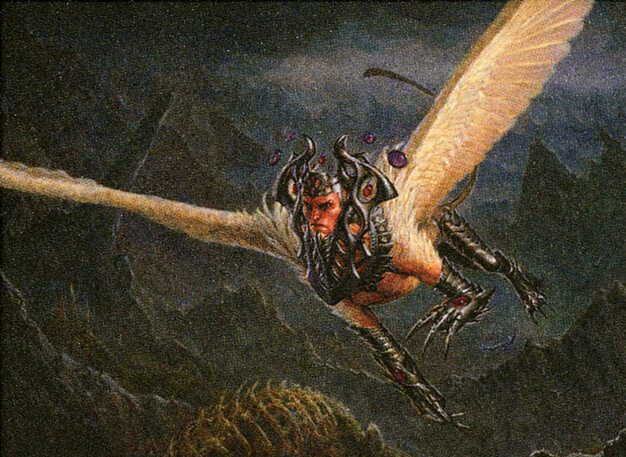
A 2009 Conflux rare artifact creature carries an almost fixed default story: watch the enter that sets a life total to 10, watch Esper cheat and blink sidebars, watch “useful but replaceable.” Magister Sphinx’s card face (Scryfall) reads like that part. Cost {4}{W}{U}{B}, 5/5, flying. When it enters, target player’s life total becomes 10. In Commander, starting at 40, that often means shaving about 30 in one hit. It can also slam infinite lifegain back to ten. MTG Rocks (2026-10-09) pinned the old identity tightly. It shows up in lists like *Yennett, Cryptic Sovereign*, *Sharuum the Hegemon*, *Aminatou, the Fateshifter*, and *Breya, Etherium Shaper*, living on cheat-into-play, blink enters, and the artifact type line. Useful, rarely mandatory. Default logic therefore almost writes itself. Old rare, parasitic on a narrow identity, not a new-set face card—price should sleep in bulk.
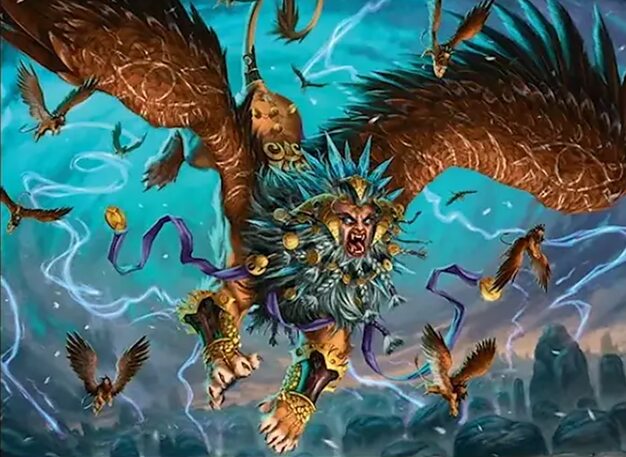
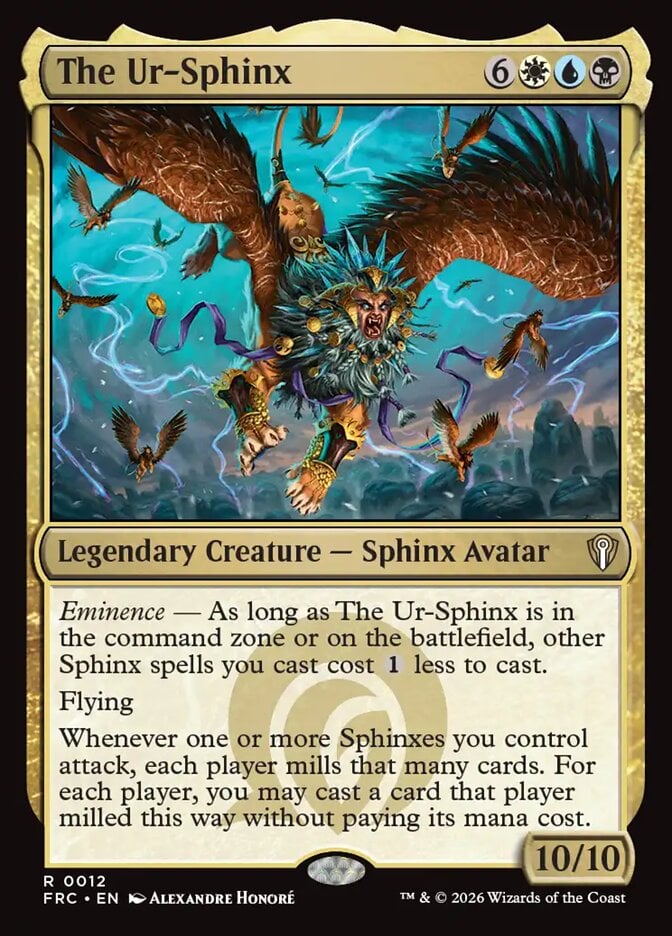
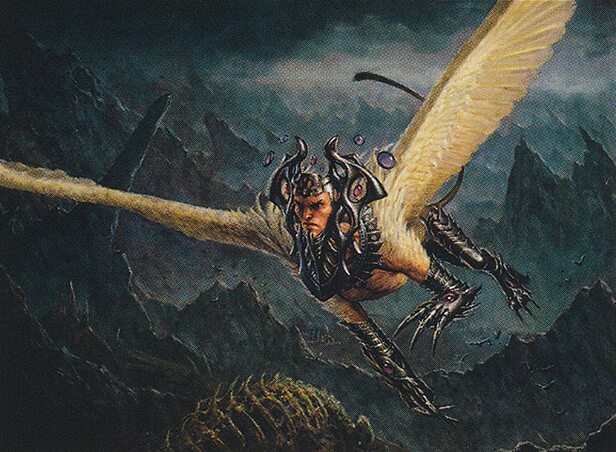
*The Ur-Sphinx* breaks that default. The Scryfall page (FRC#12, *Reality Fracture Commander*, released 2026-10-02, art by Alexandre Honoré) is blunt. Nine-mana legendary Sphinx Avatar, 10/10, flying. Eminence works from the command zone or the battlefield, making other Sphinx spells you cast cost {1} less. Whenever one or more Sphinxes you control attack, each player mills that many cards, and for each player you may cast a card milled that way without paying its mana cost. Command-zone discount rewrites the tribe from expensive-and-slow into a queue that can enter. The attack trigger writes mill-and-steal-cast as the endgame. MTGGoldfish’s October 4 weekly (published October 5) already said Ur-Sphinx was still pushing random Sphinxes up, and flagged *Azor, the Lawbringer* jumping more than 200% to about $9 that week. The author added a key judgment. Before Ur-Sphinx spoiled, the tribe was fairly cheap to build in Commander. After, a pile of never-reprinted mythic Sphinxes spike easily with demand.
Magister Sphinx sits at the center of that curve because list density wrote it as an auto-include. Draftsim’s weekly covering October 3–9 put the Double Masters 2022 printing from about $1–$2 up to about $4.50, and wrote that roughly three of four Ur-Sphinx decks run a Magister. MTG Rocks, tracking the same wave with EDHREC numbers, was harder: about 3,510 Ur-Sphinx lists, about 76% inclusion. After the discount, a seven-mana enter that rewrites life totals is almost automatic for the tribe. Default logic says old parts should be cheap. After Eminence discount and three-quarters copying stacked, the shelf refused to keep reading only that sentence.
2. Reprint buffer and etched premium
Price tables still look like seasonal weather. Printing depth rewrites weather into climate.
Magister Sphinx is not a single-printing mythic. Scryfall’s checkable paper printings are at least four lines: Conflux #116 (2009), Archenemy #89 (2010), Double Masters 2022 #247 regular and foil, and same-set #519 foil-etched. MTGGoldfish’s October 11 weekly (published October 12) turned that into a finance sentence. Magister Sphinx gained about 100% to 260% that week, landing near $4 depending on printing. The author exhaled in the same breath. Several reprints should keep prices from going as crazy as some never-reprinted Sphinxes. The same paragraph immediately added the exception. The Double Masters 2022 foil-etched jumped from about $3 before Reality Fracture to about $40. Reprint buffer presses the regular rare curve. It does not press collector etched premium.
MTG Rocks tracking around October 9 sliced the layers finer. Conflux near-mint sat near $0.69 about a month earlier; after the spoiler, sales rose, near-mint listings once shrank to about eleven copies, cheapest near $4.59, about +565%. Regular Double Masters went from about $0.82 to about $3.99. Foil-etched from about $3.09 to about $33.99. Archenemy from about $0.45 to about $9.99. The window closed faster than the slogan “lots of reprints, so it stays cheap.” Draftsim that same week had regular 2X2 roughly doubling into the mid-fours. The next week, regular did not stop. TCG Strat’s October 22 Index put 2X2 #247 nonfoil near $12.49 versus about $3.75 on October 15, about +233.1%. Budget-tier Conflux #116 on the same page sat near $4.88 versus about $2.53 on October 15, about +92.9%. Scryfall spot prices at write time point the same way. 2X2 #247 nonfoil about $11.82–$12.27, foil about $3.92. Etched #519 about $14.74. Conflux #116 about $4.88. Archenemy #89 about $1.42. Azor, the Lawbringer (RIX #154, mythic, almost no formal reprint) about $12.83.
Etched premium and regular price moving out of sync on the timeline is more useful than a single screenshot. Goldfish’s weekly and MTG Rocks caught the spike inside two weeks after Reality Fracture, etched briefly into the thirties and near forty. At write time Scryfall etched sat near $14.74—off the peak, still far above the pre-spoiler floor near three dollars. Regular nonfoil kept climbing; TCG Strat’s weekly gainer table pushed it near $12.49. Non-etched foil instead slept near $3.92, under the set’s nonfoil. The market is trading three curves on one Oracle text at once: tribal copying, reprint supply, etched collecting. Collapsing those three into “Ur-Sphinx is hot so Magister is expensive” turns a printing-depth ledger into a single-card myth.


3. Scarcity tax inside a wide spread, against never-reprinted mythics
If you only watch Magister Sphinx, the story narrows to “a Conflux rare got expensive again.” Pull the camera to *Azor, the Lawbringer* in the same Sphinx Season wave, and to the buylist spread TCG Strat marks as wide, and you see another grammar running in parallel on the secondary market. One piece of cardboard can still be pushed into double digits by list density despite multiple reprints. Another can spike earlier and steeper on the same tribal curve because it is a never-formally-reprinted mythic. Keep those two ledgers apart; do not merge them into “Sphinxes are hot.”
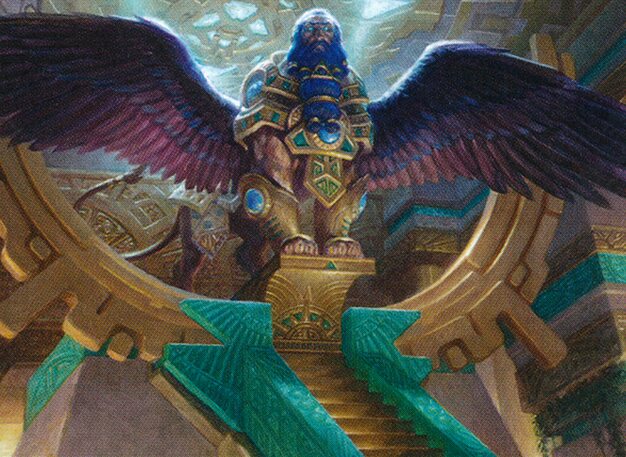
Azor (Rivals of Ixalan #154, mythic) was already written by MTGGoldfish’s October 4 weekly as more than +200% to about $9. Scryfall nonfoil at write time sat near $12.83. Print surface is almost one formal set plus a promo. The Goldfish author pointed at cards like this as samples that spike easily with demand. Magister has four paper printings; Azor almost has one. Same season, same tribe, value grammar still splits into two books. Magister shows reprint buffer can delay a frenzy without stopping three-quarters list density from draining listings. Azor shows a never-reprinted mythic on the same Eminence-discount curve writes scarcity into price faster.
Wide spread writes the scarcity tax into the store end. TCG Strat’s October 22 gainers table ranked Magister Sphinx 2X2 #247 first for the week, and listed Card Kingdom retail near $2.79 and buylist near $0.95 as about 92% wide. The same page’s wide-window list repeats buylist about $0.95 against market about $12.49. Wide means something concrete. Store cash offers are not keeping up with open-market climb. Sellers who take buylist give up most of the paper gain. Sellers who list themselves get closer to market and pay time, fees, and shipping. Spread itself does not create demand. It exposes demand already running ahead of store reprice rules.
MTG Rocks also left room in its forward look. Magister had Commander homes before Ur-Sphinx. It may also be a trend spike that cools when the next shiny thing arrives. Downstream product windows such as Star Trek sit closer than usual. This piece does not make buy-or-sell calls for the reader. It only reads the public layers cleanly. Regular reprints, etched premium, budget Conflux, never-reprinted Azor, and a 92% wide window—five lines side by side—show where the tax is actually written.
4. Return: what tribal demand writes onto listings is printing depth
This wave rewrites where the Sphinx tribe sits on the timeline.
Before the spoiler, it could be written as a cheap side path. After Eminence returned, the nine-mana sovereign in the command zone turned other Sphinxes into discount creatures you can queue. Magister Sphinx, on enter-rewrite-life plus list density, was first written as the weekly spike lead by Draftsim and MTG Rocks, then by TCG Strat on October 22 as about +233.1% and weekly number one. Reprint buffer did not vanish. It only delayed frenzy from immediate-forty into first-four-fifty, then-twelve, while etched ran a separate spike-and-cool curve. Never-reprinted mythic Sphinxes filed another invoice earlier.
What the secondary market has been writing onto listings these days is printing depth times tribal copying. Single-card myth only pulls the eye. Under that pull sit four printings, one etched line, one wide spread, and Azor’s almost-no-reprint contrast. Tear the poster off; the ledger remains.
Readers who want one trail can open three pages together. Scryfall’s Magister Sphinx printings and *The Ur-Sphinx* page, to check Oracle and print lines. TCG Strat’s Double Masters 2022 set page and movers, to check 2X2 #247 and CON #116 from October 15 to 22. MTGGoldfish’s October 4 and October 11 weeklies, to check the Azor sentence and the etched-foil sentence the weeklies already locked. Numbers will keep wobbling. The printing-depth ledger will not vanish with the poster.

Sources and further reading
TCG Strat movers (updated 2026-10-22)
TCG Strat Double Masters 2022 set page
MTGGoldfish Weekly Update (Oct 11 week, published 2026-10-12)
MTGGoldfish Weekly Update (Oct 4 week, published 2026-10-05)
Draftsim weekly spikes (approx. 2026-10-03 to 10-09)
MTG Rocks (2026-10-09) Magister Sphinx MTG Price Spike
SpellBook Finance Magister Sphinx (2X2)
Scryfall Magister Sphinx (2X2 #247)
Scryfall Magister Sphinx etched (2X2 #519)
Scryfall Magister Sphinx (CON #116)
Scryfall Magister Sphinx (ARC #89)