

If the default hero arc in indie storytelling is still “young, broke, sleepless, overnight hit,” then what Reddit user u/exile-dev posted on r/gamedev on 17 October 2026 (Asia/Hong_Kong) rewrites that script on another clock: after twenty years, he stepped out of the “expected life” of corporate IT and spent two years solo, driving the childhood magic of a Commodore 64—where you rebuild the game every day—back into Godot’s scene tree.
The post is not a launch trailer and not a wishlist campaign. It reads more like a late ticket of entry—the author admits years of lurking, reading other people’s post-mortems, finally willing to “step out of the shadows and say hi.” The project is *Guiltwood*: a turn-based 2D survival RPG that joins Slavic folklore with psychological horror. This essay has not playtested the game; scenes and claims below are anchored to the public self-report and verifiable links, with uncertainties marked as source observation.
The image that runs through this piece is that “simple tree.” One chop in the player’s eye is two weeks of architecture in the maker’s; and what midlife career-change really has to cut open may be the bark between “still not too late” and “must admit I cannot finish alone.”
1. The Default Logic: Solo Means Omnipotence, Career-Change Means Catching the Young
Industry default logic loads “solo” with near-mythic expectations: one person codes, paints, composes, cuts the trailer, and preferably also understands publishing and community. Social media compresses the myth into shareable slogans—“passion is enough.” Midlife switchers get squeezed from both sides: the real weight of rank and family, and the invisible clock whispering that you started too late.
The author of *Guiltwood* makes that default concrete. He remembers an ASCII rocket on a Commodore 64 in early elementary school; around eleven he played with the Shoot-’Em-Up Construction Kit, barely understood English, never figured out saving to tape, and so rebuilt a new game from scratch every day—maybe more fun that way, he says now. A few simple games at university, then twenty years making a living in corporate IT. He never stopped playing titles with deep systems and mod support, because mods let him twist other people’s games toward his own vision.
The reality check is classic: most of a life spent doing what was expected, not what gave meaning. Skills in hand, love of games intact, he decided this was probably the last real chance to build something that mattered to him. So he installed Godot and started from tilemaps, scenes, turn logic, and movement.
Here comes the first crack in the default: he does not pretend to be a twenty-year-old polymath; he brings an engineering brain straight into the engine—even asking why almost nobody does true 3D-style directional shadows in a top-down 2D game. Three months later he knows why, after a rabbit hole of viewports, raw data maps, and custom shaders. Source observation: this reads more like a learning dive than a must-have feature list.
Read the three-month shadow dig beside the two-week tree, and the same ethic appears: an engineering mind will pay for unsolvable questions and will also pay full schedule for solvable ones. Default logic tells you to collect features on a wishlist; he prices features in calendar time—and only after the price tag does scope become negotiable.
Two weeks without boredom became two months, six months, then two years of steady progress. The default said you would quit early; the schedule itself answered back.
2. Smashing the Script: Seeing Hidden Architecture in “Chop a Tree”
What gives the self-report its producer weight is not motivation-speak but the tree.
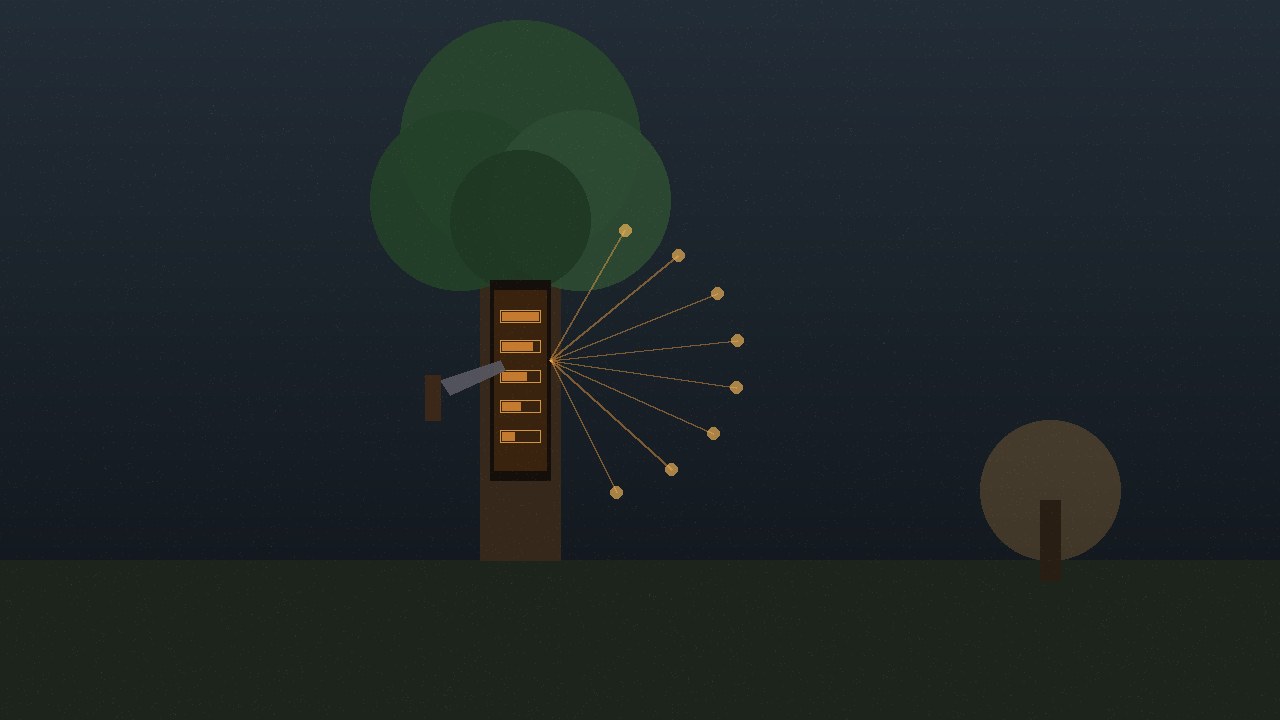
He writes: you decide “the player should chop down a tree.” So simple. Then the list unfolds—the tree must block movement; the player must walk near it; you need a chopping animation; the tree needs HP; the axe needs a damage type and durability; persistence so a felled tree stays down when a chunk unloads; a physical fall, which means a falling animation, despawn, spawning wood logs, scatter placement by fall direction… Suddenly a “simple tree” is two weeks of architecture.
This recalibrates the word *mechanic*. Industry default often writes gameplay as one line on a feature sheet: Chop Tree. Production splits it into collision, animation state machines, damage pipelines, durability, serialization, physical presentation, and spawn rules. He admits that solving those problems is exactly what keeps him motivated.
Press the scene into tangible detail: if the editor only holds a decorative static sprite, chopping is a VFX; if the world must remember “a tree once stood here” after the player leaves, chopping becomes a save-game contract. In the public post, persistence and chunk unload are named—evidence that he cares not only about the swing on camera, but about whether the world stays honest.
3. A Reality Check in the Hall: Systems Skill Is Not a Solo Ship
At the Swiss Game Conference, strangers sat down and played a prototype that did not exist two years earlier—immensely rewarding, and a massive reality check. He saw the boundary quickly: programming, shaders, and systems he can carry; capsule art, music, and sound design, if still fully solo, would push release toward “2050.”
The sharpness of that line is its refusal to use “indie” as a fig leaf. Independence is often misread as never outsourcing, never collaborating. His path is the opposite after two years solo: admit the sensory layer cannot be fully owned, then find peers—he mentions joining the Midlife Crisis Indie Game Dev Community, developers in similar life situations. Solo is isolating; talking with people who share the same doubts, energy dips, and scope fights changed his perspective. He calls it the start of a new chapter, or the next level: basics and rules known, but no longer traveling alone.
Source observation: as of this writing (18 October 2026, Asia/Hong_Kong), public search found no Steam or itch store page for *Guiltwood*; the project mainly surfaces through the author’s Reddit self-report and the conference prototype, with no store link in the post.
Closing: Independence Is Continuing to Build After Admitting You Cannot Finish Alone
Put the post back into the 2026 indie floor, and what it strikes is not “young people make games,” but a quieter age shame—as if passion expires, as if twenty years of IT were only waste, as if solo must equal the omnipotence myth.
exile-dev’s counterexample is clumsy and honest: from daily C64 restarts to two steady Godot years; from a three-month shadow rabbit hole to a two-week tree; from conference excitement to admitting art and audio cannot be finished alone; from lurking to stepping out to say hello. Clumsy, because it will not compress into a short video; honest, because it separates meaning from scope.
So *independence* can be redefined here. It need not mean one person carries the box art to gold master; it can mean that when resources are tighter and age heavier, you still ask which systems are the problems you truly want to solve, and which sensory layers must go to other hands. Making need not mean stacking features; it can mean writing the architecture a “simple mechanic” deserves—then admitting there is still a world beyond architecture.
Short, executable prompts:
- Write your “one tree” list: take a one-line mechanic and force it into collision, animation, numbers, persistence, presentation, and failure states; estimate real calendar cost.
- Give midlife / part-time switchers a steadiness metric: not daily-update myth, but sustainable weekly progress; two weeks without quitting beats two days of highlight streaming.
- The moment strangers can play the prototype, open a separate “I cannot finish” list: art, music, SFX, publishing—name what must be collaborative instead of shaming it into 2050.
- Find same-stage community, not only younger prodigies; matched doubt sometimes saves more lives than one-way pep talks.
For anyone still at an office desk wondering whether it is too late, the post does not promise a hit. It promises something scarcer: you can still begin; after beginning, you can still admit you cannot finish everything; after admitting that, you still need not walk the path alone.

Sources and Further Reading
- Source observation: no public storefront found for *Guiltwood*; Swiss Game Conference prototype and Midlife Crisis Indie Game Dev Community per author self-report; no independent venue verification in this essay.