

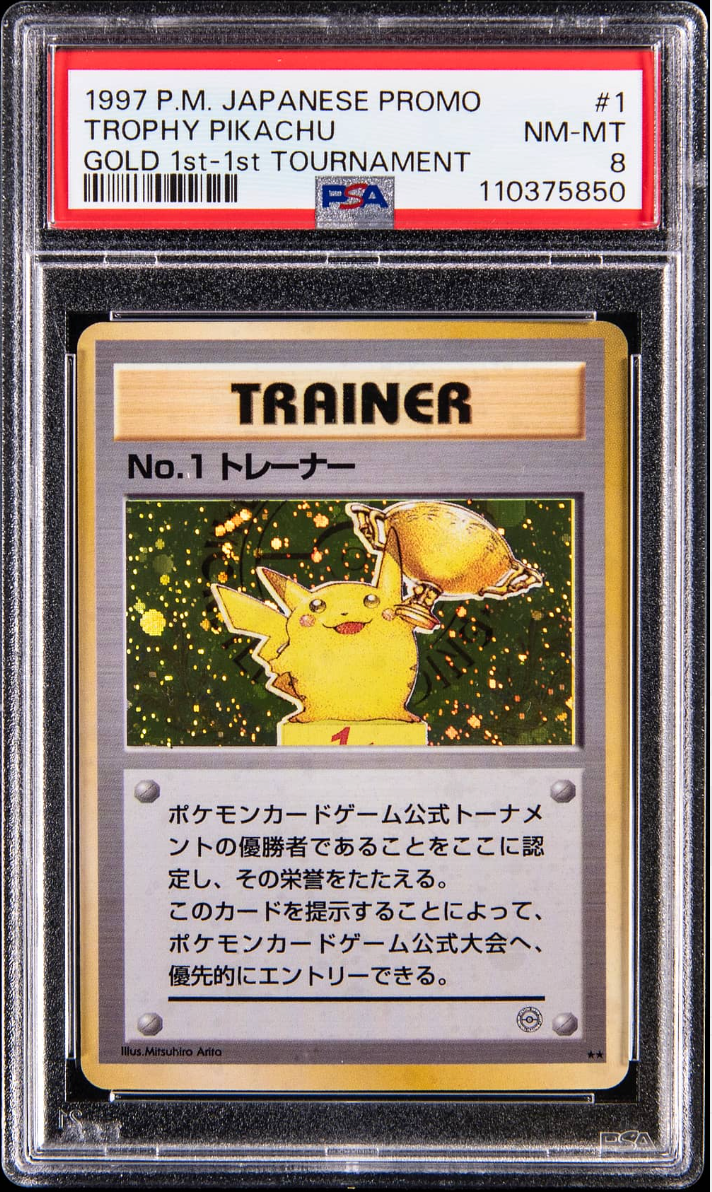
If the first official Japanese Pokémon TCG tournament at Makuhari Messe in June 1997 placed a Gold Trophy Pikachu in a single champion’s hands, and if for the next twenty-nine years most collectors only met that card in population reports and rumor, then Goldin’s Pokémon 30th Anniversary auction in October 2026 pushed the same piece of paper onto a public bidding floor. At the time of writing (morning of 2026-10-25, Asia/Hong Kong), the hammer has not fallen. Close is scheduled for about 10 p.m. Eastern on 25 October, plus thirty-minute extended bidding, roughly the morning of 26 October in Hong Kong. The image that runs through this piece is the gold trophy held above Pikachu’s head, and the single remaining cell for this card in PSA’s census. Only one Gold was awarded. On a population of one, grade no longer discounts the price.
I cross-checked Pack Report’s 8 October and 14 October features, Tokyo Card Concierge’s 9 October update, TCGCharts’ 16 October Market Pulse, and the live Goldin lot page the same morning. Boards can differ by tens of thousands of dollars; the direction matches. The numbers will keep moving. This piece cites only public figures I have verified, and it keeps bids separate from paid sales. Pack Report called this the headliner collectors had talked about for years and never seen sold. That is the line this article follows.
1. One gold at Makuhari, one cell in the census
The hobby’s default logic is clean. High grades earn premiums; lower grades take discounts. A PSA 10 belongs in seven figures; a PSA 8 should step down a rung. The Bronze record wrote that default in hard numbers. In May 2026 Goldin sold a 1998 3rd Tournament Bronze 3rd Place Trophy Pikachu in PSA 10 for a $1.45 million hammer, $1.769 million including the 22% buyer’s premium, then the public record for any Trophy Pikachu. The grade sat at the front of the buyer’s reason. A bidder could say, this is the only 10 of that card.
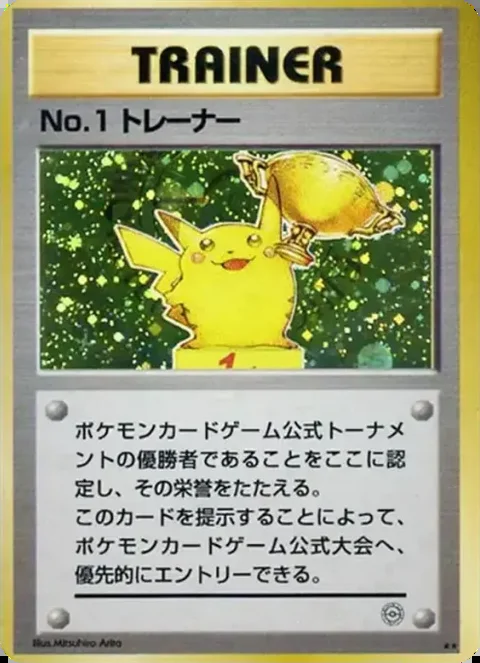
The lot in front of us breaks the default. Pack Report and Goldin’s lot title list it as the 1997 Japanese Promo Gold 1st Place 1st Tournament #1 Trophy Pikachu. Mitsuhiro Arita’s Pikachu lifts a gold trophy with a “1” on the base, standing on a podium marked with a red 1. The header reads TRAINER and No.1 トレーナー. It was never shop stock. It was a prize for a final placing.
In June 1997 the first official Pokémon TCG tournament was held at Makuhari Messe in Chiba. The game had launched in Japan only the previous October; the event sits almost at the start of print history. Gold for first, silver for second, bronze for third. Later tournaments reused the gold-silver-bronze design, which is why Bronze and Silver copies still surface, and why the May Bronze could post $1.769 million in PSA 10. A Gold 1st Place from the first tournament is a different object: one event, one winner, one card. Nearly thirty years of storage, trade, and play thin the high-grade survival rate further. This copy is graded PSA NM-MT 8, cert 110375850, and is the only example of the card in PSA’s population report. Nobody is waiting for a cleaner copy of the same printing. The empty cells in the census are harder than the grade number.
Tokyo Card Concierge separately recorded a Gold 1st Place PSA 8 at Goldin in March 2026 for $982,100. Whether that sale was the same first-tournament printing is not consistent across public reports. This piece stays with Pack Report’s locked description: first-tournament Gold, population one, and never before sold publicly. When you check a lot, match tournament, place, and year on the label, not only the word Trophy.
2. The bid ladder, and a grade ladder turned upside down
The bid ladder is hard enough without adjectives.
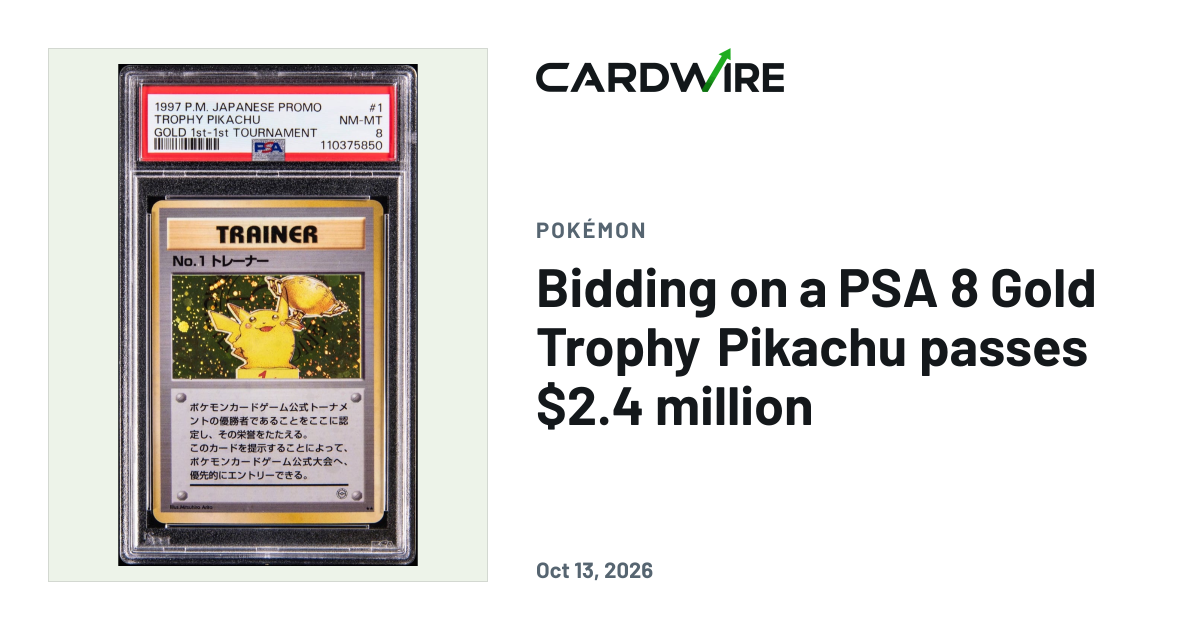
Cross-checked public readings from Pack Report and Tokyo Card Concierge put pre-bidding open around 6 October. CardWire noted an opening neighborhood of about $250,000, then a fast climb: about $975,000 on 7 October; about $1.925 million on 8 October; about $2.225 million on 9-10 October. On the afternoon of 14 October, Pack Report had the lot at $2,425,000 before premium after 31 bids, about $2,958,500 with Goldin’s 22% buyer’s premium. On the morning this piece was written, the Goldin lot page read $2,525,000 with 32 bids, about $3,080,500 including premium. The hammer has not fallen. Extended bidding is concrete: after the scheduled close, every lot stays open thirty minutes; any higher bid on a given lot resets that lot’s timer by another thirty minutes until thirty minutes pass with no new bid. All of the above are bids, not settled sales.
Set the ladder against the May Bronze record. Bronze is PSA 10 at a $1.45 million hammer. Gold is PSA 8, and by 14 October its pre-bid already sat about 67% above that hammer. Pack Report printed that comparison while the auction was still in pre-bidding. On a population of one, grade stops acting as a discount code and becomes a description of the paper that exists. The buyer is purchasing the only slabbed copy, not shopping a row of the same card for a better number. Pack Report made the same point about the Illustrator ladder in August and the Pristine Rayquaza in September: the scarcer the top rung, the less the grader’s number moves the price. The grade remains on the label. It describes corners and surface. It no longer decides whether this card should sit a full step cheaper than the Bronze.
3. Six-figure undercards, and hammers that are not yet paid
The sale is not only this lot. Pack Report logged undercard bids around 10 October, before premium: 2003 Skyridge Gengar #H9, BGS Pristine 10, about $122,000, set against a PSA 10 of the same card that sold for about $150,000 on eBay in August, Pack Report’s label-premium check. 2002 Legendary Collection Charizard reverse holo PSA 10, about $110,000. 2000 Black Star Eevee League promo PSA 10, about $110,000. Sealed 2005 EX Deoxys booster box, about $110,000, the set that produced the Rayquaza Gold Star; the sealed box is another way to hold it. 2006 EX Holon Phantoms Gold Star Mewtwo #103 PSA 10, about $105,000. The same week also carried six-figure asks on a Black Star Venusaur promo and a sealed EX Team Rocket Returns box. The undercard proves the width of a thirtieth-anniversary sale. The headliner rewrites the short list of tournament promos.
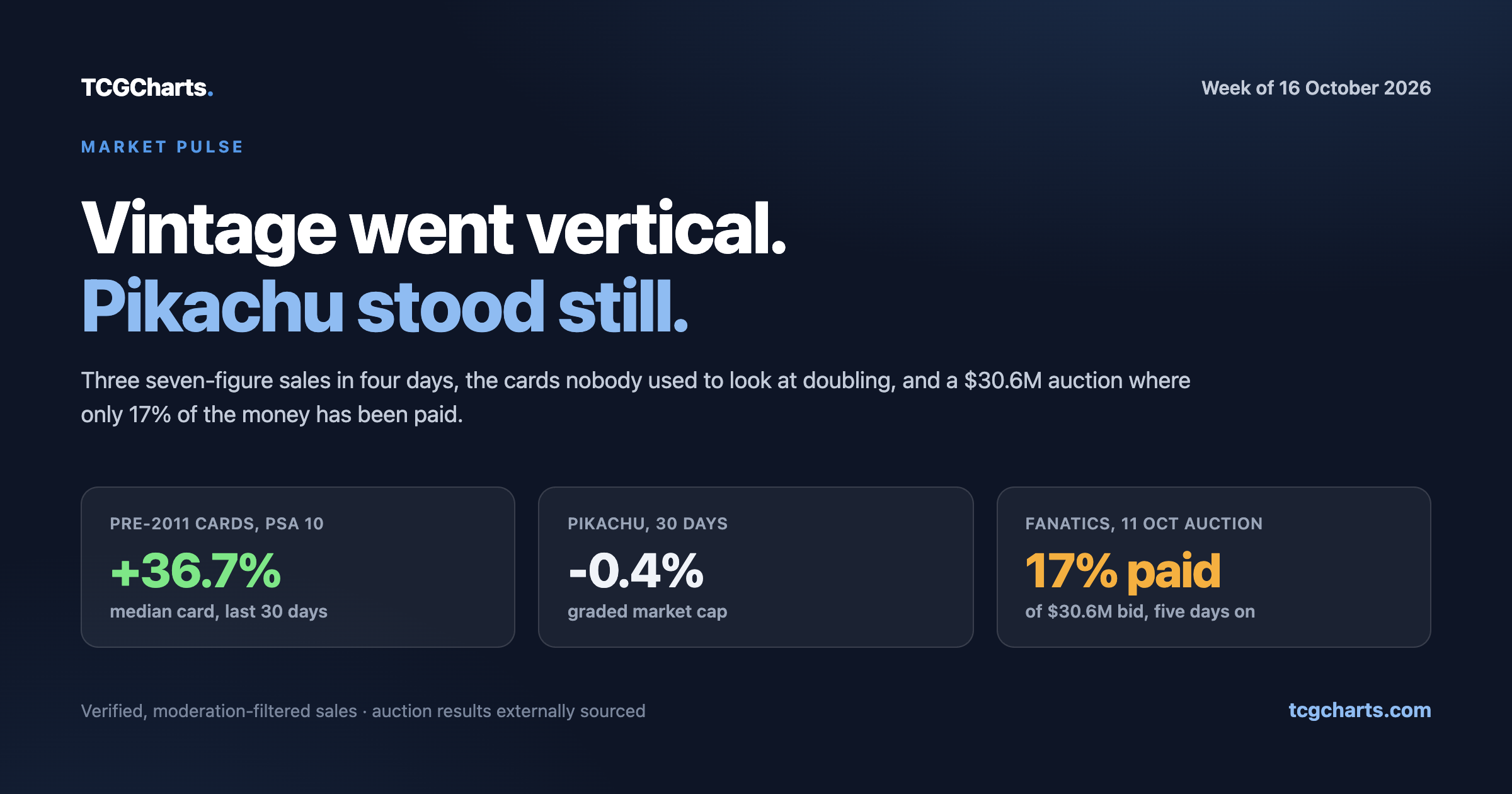
TCGCharts’ 16 October Market Pulse opens the larger ledger. The Pokémon 200 index read 2,911, about +5% over two weeks, roughly half a percent below its all-time high. Pre-2011 PSA 10 median about +36.7%, with roughly nine in ten of 307 cards higher. 2011-and-later PSA 10 median about −7.3%. Vintage rose; modern retreated. Grail 25 dipped in the same window because its weight leans modern and leans modern Pikachu promos. The same issue covered Fanatics Collect’s 11 October weekly auction: about $30.6 million bid, only about $5.3 million paid by Friday, about 17%. Fanatics lots clearing at more than three times a card’s recent price stay out of TCGCharts prices until paid. Pack Report and TCGCharts hold the same discipline. An unpaid hammer is not a price.
Art Academy Raincoat Pikachu is the sharpest parallel for that discipline. In September a PSA 10 cleared about $8.4 million at a Fanatics weekly. Fourteen days later, another PSA 10 of the same card closed at Goldin for about $1.037 million including premium. Same card, same grade, fourteen days, a seven-million-dollar gap. TCGCharts’ reading is cold: for a card with a tiny population there is often no reusable market price, only the story of what one buyer paid on one night. This piece uses Raincoat Pikachu only as a cautionary coordinate, not as a valuation for the Trophy. An optional historical coordinate is Goldin’s February 2026 “151” sale, where Pack Report recorded an Illustrator at about $16.5 million. That shows seven-figure Pikachu promos already have a public precedent. It does not replace a hammer that has not yet fallen tonight.
4. Until the hammer falls, a listing is only a listing
What this card rewrites is where tournament promos sit on the timeline.
Before the spoiler, Trophy Pikachu mostly lived in census tables and private rumor. The May Bronze PSA 10 first pinned the public record at $1.769 million. This October’s first-tournament Gold, population one, PSA 8, already passed that hammer in pre-bidding, and on the morning this piece was written read $2,525,000, about $3,080,500 with premium. The number can still move in extended bidding. Population one will not vanish with the posters. Grade here describes condition; it does not discount the buyer. Once a sale completes and is paid, silver and bronze on the short list, and golds from other tournaments, get repriced. Pack Report put it briefly: the list is short, and until now it was quiet. After the quiet breaks, the ladder has to be rearranged around a new top rung.
Readers who want a single thread can open four pages at once. Goldin’s 2026 Pokémon 30th Anniversary lot page, for the live bid and extended-bidding rules. Pack Report’s 8 October and 14 October pieces, for the bid ladder, the roughly 67% hammer comparison, and the six-figure undercard. Tokyo Card Concierge’s 9 October note, for Makuhari’s first tournament and the reminder that a bid is not yet a sale. TCGCharts’ 16 October Market Pulse, for the Pokémon 200, vintage versus modern medians, and Fanatics’ roughly 17% paid. The numbers will keep moving. Until the auction hammers, a listing is only a listing. The population-one Gold trophy has already been rehung at the top of the tournament-promo ladder.

Sources and further reading
Pack Report (2026-10-14) Trophy Pikachu bid to $2.4M
Pack Report (2026-10-08) Goldin 30th Anniversary auction opens
Tokyo Card Concierge (upd. 2026-10-09) Gold Trophy Pikachu
TCGCharts Market Pulse (2026-10-16)
Goldin lot page: 1997 Gold 1st Place 1st Tournament Trophy Pikachu PSA 8