

If the secondary market after a new set opens has a default script that almost never fails—sealed product and draft pouring mythics onto shelves like sand, the “expensive paper” on the preorder list collectively pressed to half price within two to four weeks, while Commander enthusiasm pads a foam layer under a few face cards—then October 2026’s *Reality Fracture* almost performed that script in public and tore out one page at the same time: on the same “ten priciest before release” list, nine sank at a median of about −52.5%; only *The Theorist, Jace Beleren* climbed from a preorder of about $32.97 to about $63.49 regular nonfoil on October 19, roughly +93%.
That sentence sounds like another “Jace heat.” What actually carries weight is not the percentage screenshot but the direction of gravity: money is not chasing the empty claim that “new-set mythics are always briefly expensive,” but a verifiable table—among Standard Challenge top-32 lists in the October 1–16 window, this planeswalker appeared in 93 of 627 lists, the most-played mythic from the set; Jeskai/Azorius Artifacts and Dimir control each took about twenty-nine copies, plus scattered Izzet. The secondary market suddenly found itself pricing “sixty-card tables still buying,” not “the loudest face at crack.”
The image that runs through this piece is **set gravity**. Gravity defaults downward: once sealed supply opens, mythics fall toward the floor. Jace moves up because another force—repeat purchases in Constructed formats—yanked the same sheet of paper off the set’s orbit.

1. Default logic: sealed flood = mythics down, preorder expensive paper depreciates on schedule
Industry default logic is clean, and therefore lazy.
A new premier set lands; the default narrative is almost fixed: watch the preorder list, watch mythics, watch “can cracking boxes pay back.” Sealed and draft slam paper into the secondary market in the weeks after release; preorder prices get treated as an “emotion peak,” not a “table clearing price.” In its Reality Fracture price review updated October 19, BaseMTG wrote that lazy logic into an almost cutting comparison table—MTG Rocks’ September 24 preorder list against Scryfall’s October 19 regular nonfoil prices:
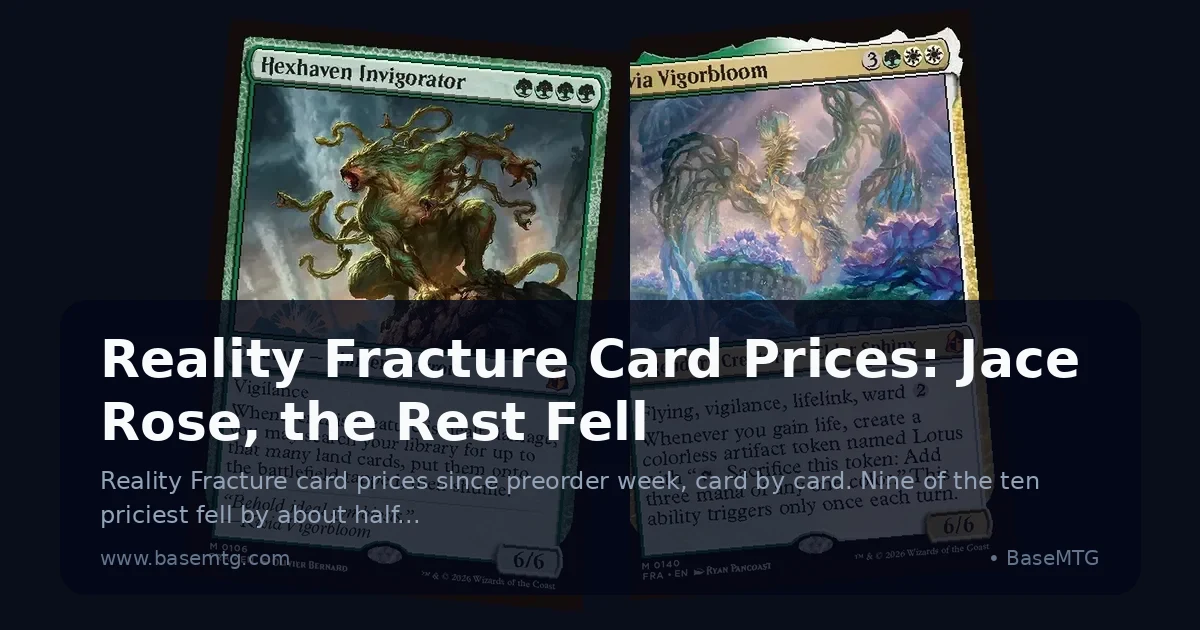
*Emrakul, Exigent Doom* $38.06→$17.74 (−53%); *Hexhaven Invigorator* $35.99→$27.29 (−24%); *Samut, Tyrant* $32.40→$6.12 (−81%); *Ajani, Resolute* $22.97→$11.11 (−52%); *Darklight Phoenix* $21.98→$11.22 (−49%); *Stingcaster Mage* $21.97→$4.64 (−79%); *Kwia, Vigorbloom* $21.51→$8.79 (−59%); *Omnipresence* $20.95→$2.44 (−88%); *Craterclaw Colossus* $20.46→$11.05 (−46%). Nine of ten cheaper; median drop about −52.5%.
Default logic says: new mythics should fall. The shelf says: most of them are falling. The exception stings because it refuses to join the chorus.
The table’s cruel honesty is that it does not ask you to believe any empty talk about “set quality.” Nine cards can complete the standard arc “expensive on preorder → cheaper after cracking” at once, while a tenth uses another arc—repeat Constructed purchases—to rewrite “must fall after release” from iron law into a conditional guess. Set gravity still exists; it simply no longer treats every mythic the same.
2. Smash the script: not nostalgia premium, but sixty-card tables buying again
If the drop table still looks like seasonal weather, Standard lists rewrite weather into climate.
BaseMTG’s cited Challenge slice is concrete: October 1–16, Standard Challenge top-32, 627 lists total, *The Theorist, Jace Beleren* in 93—highest among mythics from the set. The Constructed cut is not fuzzy either: about twenty-nine Jeskai/Azorius Artifacts, about twenty-nine Dimir control, plus scattered Izzet. The card itself (Scryfall FRA#43) reads like an engine control wants to hold long-term: cost {2}{U}{U}, loyalty 3; at each opponent’s draw step you also draw; +1 make a 1/1 Illusion; −2 bounce up to one artifact or creature per opponent; −6 draw three, then put +1/+1 counters equal to cards in hand. Art by Ekaterina Burmak—the theorist’s eyes are cold; the numbers are hot.
Price track and list counts move together. Draftsim’s weekly (covering 10/10–10/16) wrote: regular was just above about $40 the prior Friday, well past $60 by writing time, briefly near $70 then cooled slightly. MTGGoldfish’s October 18 weekly update (page date landing October 19) put it closer to the counter: last week still asking whether, after $30→$50, it might be the next $100 card; this week it sits near about $70, having peaked near about $90; on the SCG LA floor, vendors could barely keep stock—cross-format demand vacuumed inventory. BaseMTG and Scryfall align on October 19 at $63.49 regular nonfoil; versus September 24’s $32.97 preorder, about +93%. In the short October 13–19 window it slipped from $69.12 to $63.49—cooling after the climb does not send it back to set gravity’s floor.
The morning piece covered Aminatou and the Superfriends loop: that was a Commander secondary-market spike, parts suddenly repriced because of a demonstrable loop. Jace’s grammar is different. It is not “a nail suddenly welded into someone else’s 99,” but “sixty-card tables writing the same mythic into lists every week.” The former is a seasonal storm; the latter is sustained updraft.
3. Split the ledger: high Commander counts still cannot stop set gravity; foils and playable paper are two books
If you only stare at Jace, the story narrows into “another expensive Jace.” Pull the lens to the same preorder top ten and Reality Fracture really demonstrates two parallel ledgers: one written by Standard (plus Pioneer Dimir and Modern Scepter-Chant one-ofs); one still written by sealed flood and “looks good almost only in Commander.”
EDHREC deck counts do not speak for price on everyone’s behalf. Jace about 27,183 decks; *Samut, Tyrant* about 16,229; *Hexhaven Invigorator* about 13,262; *Emrakul, Exigent Doom* about 13,184; *Omnipresence* about 3,164. Samut’s commander popularity is not low, yet it fell from $32.40 to $6.12 (−81%)—high EDH counts cannot stop a fall when there is no sixty-card table holding the floor after release. Omnipresence is more extreme: regular nonfoil about $2.44, Facet Foil about $472.94; Jace’s Fracture Foil about $474.44, roughly 7.5× the regular. Foils spin in collectible scarcity narrative; playable nonfoil paper must answer another question: is this week’s Challenge still running it?
The October 13–19 short window writes both books more clearly: Jace edged from $69.12 to $63.49, still far above preorder; Commander-leaning paper kept sliding—Omnipresence $3.55→$2.44, Samut $7.78→$6.12. In the r/mtgfinance thread around October 12, “The Theorist, Jace Beleren Spiking,” one side was skepticism that supply was drying, the other a reminder that “the sealed/draft mass-opening clock is still ticking.” Both were half right: the clock is real for most mythics; for the one Standard keeps buying, table noise covers the chime.
Side notes in the same window need not steal the lead: *Seasoned Cryomancer* about $10.66 and 85 lists—cheap mythics can still live on table presence; *Agatha of the Vile Cauldron* climbed from about $1 to about $13 since June’s *Marvel: Super Heroes* (Aerid Konstrari); *Radiant Solar* about $7 (Dack Fayden Helping Hand). They prove cross-format and old-card rediscovery can rewrite prices, but the main line that rewrote Reality Fracture’s “preorder top ten” gravity direction remains Jace.
4. Return flow: what “value” means after sixty-card tables rewrite set gravity
What this move truly rewrites is not a cheap opposition like “traders are smarter than players,” but where a new-set mythic sits on the timeline.
In the past, a release-week mythic’s time meaning was: expensive on preorder, cheaper after cracking, Commander hobbyists deciding which layer it settles on. Now the timeline gains a cut: is it written into this week’s sixty-card lists? BaseMTG’s top-ten comparison, MTGGoldfish’s counter shortages, Draftsim’s weekly climb, Scryfall’s $63.49—four lines point to the same scene: set gravity still acts on nine cards; the tenth is lifted off orbit by Standard’s repeat demand.
For anyone holding a cart, return flow should land on method, not chicken soup. Ask three questions first: in this mythic’s demand function, how much is sealed cracking, how much is Constructed? Does a high EDHREC count equal someone paying in weekly Challenges? Are you buying a “playable nonfoil engine,” or a “Facet/Fracture foil collectible narrative”? If the three answers are unclear, do not treat +93% as a personality certificate, and do not treat a −52.5% median drop as “nobody wants the whole set.”
Method can be even shorter: open BaseMTG’s four-week comparison, MTGGoldfish’s weekly counter narration, Scryfall’s nonfoil price, then ask once more whether the card is still on lists this week. Answer clearly and set gravity separates from table updraft by itself; answer unclear and percentages are just another spelling of noise.
Close: secondary-market “independence” means refusing to merge ten mythics under one sentence—“the new set is hot”
Put Jace’s four weeks back into Magic’s October 2026 floor, and what it hits is not speculation itself but a more hidden reading laziness—assuming the preorder list can forecast the floor four weeks later; assuming mythic drops are iron law and exceptions are only noise; assuming high Commander counts can prop post-release paper; assuming the morning Superfriends spike and the afternoon Standard engine can share one sentence, “Reality Fracture is hot.”
Public data’s counterexamples are concrete: nine of the preorder top ten at about −52.5% median; Jace $32.97 preorder → $63.49 on October 19 (+93%); Standard Challenge 93/627; Samut high EDH still −81%; Omnipresence regular about $2.44 versus Facet Foil about $472.94; Fracture Foil Jace about $474.44. Concrete, because it asks you to watch lists and listings, not only set name and rarity.
So “independence” can be redefined here. Independence need not equal contrarian shorting or refusing new sets; it can equal insisting on a split ledger inside the same Reality Fracture heat: which price belongs to sealed-flood set gravity, which to sixty-card updraft, which to foil collectible spin. Building a watchlist need not equal “buy every rising mythic”; it can equal writing first “which papers Challenge keeps buying,” then deciding whether you will pay cash for the Theorist.
Executable tips, short:
- When reading new-set mythic prices, split “sealed supply” and “Constructed demand” into two columns; if you cannot restate them, treat the average as noise.
- Reread the preorder top ten against a four-week comparison (BaseMTG already modeled it); refuse to summarize holdings with release-week screenshots.
- Keep EDHREC counts and Standard/Pioneer/Modern lists on separate tables; high commander popularity ≠ post-release price support.
- Split playable nonfoil from Facet/Fracture foil; a ~7.5× multiple is scarcity narrative, not the same “value.”
- After a spike’s small pullback (e.g. $69.12→$63.49), ask first whether tables still run it—engines that are “strong alone” deserve more room in expectations than cards that were “only loud at crack.”
October’s sealed product is still clearing. For *The Theorist, Jace Beleren*, Burmak’s theorist still stares at you; what changed is that the secondary market suddenly, while nine mythics fell under set gravity, was willing to pay again for one loyalty activation inside a sixty-card table—because someone proved set gravity can act on an entire preorder list, yet cannot stop a card Challenge keeps copying from climbing.

Sources and further reading
BaseMTG (updated/reviewed 2026-10-19): Reality Fracture Card Prices: What's Hot and What's Not
Draftsim Weekly Price Spikes (10/10–10/16): MTG Weekly Price Spikes: 10/10 – 10/16
Scryfall: The Theorist, Jace Beleren (FRA#43)
- r/mtgfinance (cited by BaseMTG, ~2026-10-12): The Theorist, Jace Beleren Spiking