

If early-2026 Pokémon secondary markets were still willing to compress an entire expansion into a single myth — oversized checklist, all-star lineup, four-figure chase cards in Pikachu ex and Mega Gengar ex, fans calling Ascended Heroes the greatest Pokémon set of all time — then *30th Celebration*, launching worldwide on the same day in mid-September, demonstrated a colder grammar: attention can be drained wholesale from last year’s “greatest” without catching the anniversary set’s singles; sealed product can stay suspended at two to five times MSRP while Special Illustration Rare (SIR) chase narratives begin to dissolve on their own.
That sentence sounds like another “new set eats old set.” What carries weight is not the phrase “anniversary heat,” but the direction of the vacuum: money and eyesight do not simply translate from Ascended Heroes into 30th Celebration god-art. They leave a “greatest set” that is still shipping in staggered waves and was reprinted again in September, then discover inside the anniversary set that singles’ median has fallen by more than half while sealed stays expensive. The image that runs through this piece is the **attention vacuum**. A vacuum is not the absence of noise; it is noise changing rooms — god-art still printing in the old room, paper unable to stand in the new one.
1. Default myth: biggest set + all-stars + four-figure chases = “greatest”; staggered product and reprints rewrite it as a drop table
Industry default logic is clean, and therefore lazy.
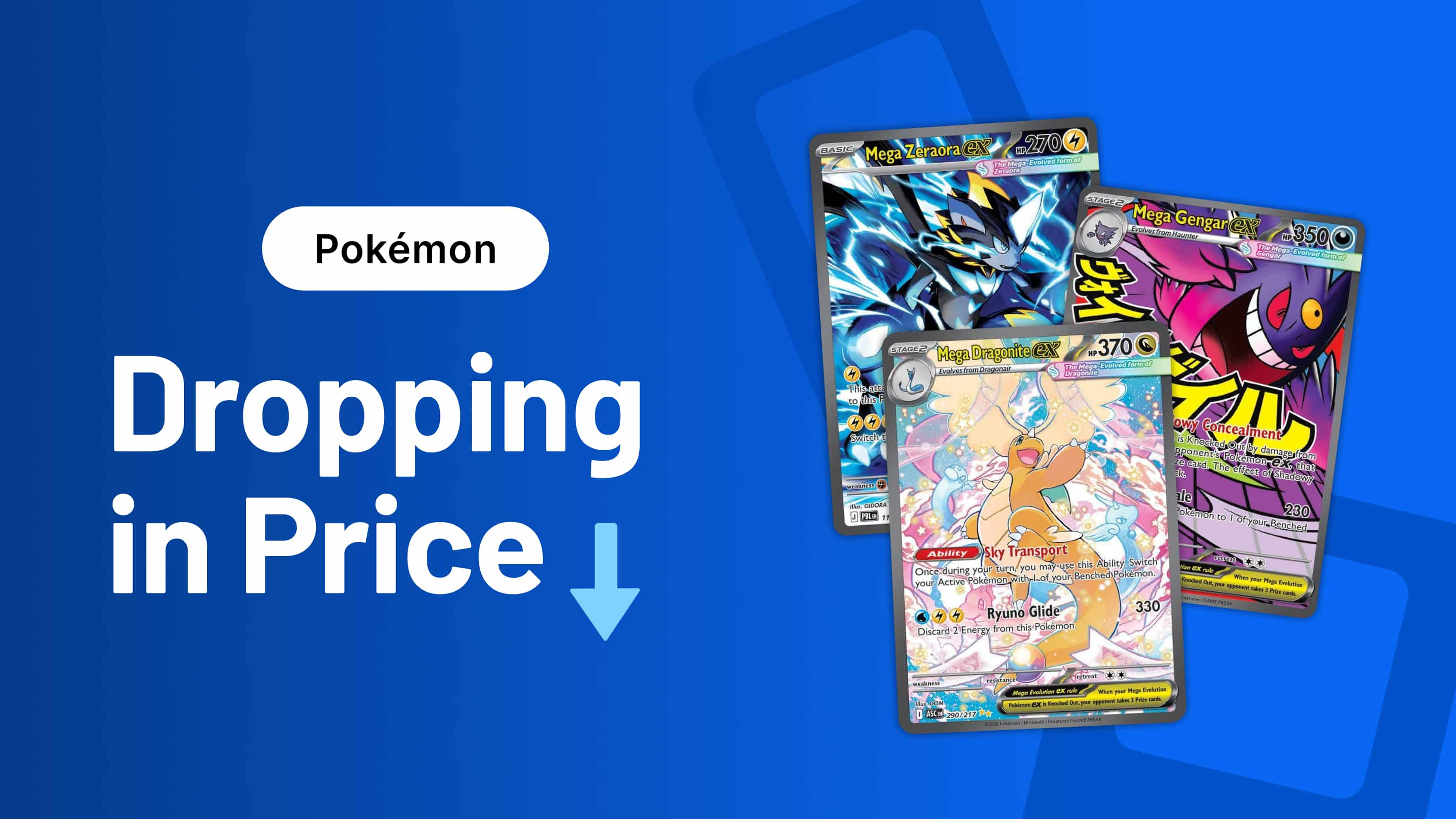
A modern expansion shouted as “the greatest” follows an almost fixed script: watch checklist size, face density, and two four-figure chases. Ascended Heroes satisfied all three at the start of the year. TCGplayer’s Seller Blog drop report on October 13 rewrote that myth as after-the-fact contrast — Near Mint copies with at least ten sales between September 7 and October 6: Mega Gengar ex 269/217 down $19.62 to about $35.88; Mega Diancie ex 282/217 down $16.33 to about $42.86; Mega Eelektross ex 278/217 down $14.05 to about $24.44. Mid-tier SIRs are not “junk nobody liked”; they are faces that opening videos once named on loop inside the “greatest set” — now walking the same downhill road together.
Higher on the curve it cuts sharper. Mega Dragonite ex 290/217 fell $101.40 in a month to about $506.15; the report says its price graph is nearly the set’s whole story: ~$500 in February, ~$875 in June, back to ~$450–506. Pikachu ex 276/217 — “Treekachu” — fell $110.87 to about $877.35; once the set’s most valuable card, it still could not escape the set’s fate. The report’s line is short: Ascended Heroes product arrived in staggered waves through the year, slowly eroding both four-figure chases and the set’s other hits; September reprints stacked with the attention shift, and Attack Rare Gengar “arrived just in time for everyone to be distracted by 30th Celebration.”
The same window echoes other modern sets: Pitch Black’s Mega Zeraora ex 114/084 down $15.69 to about $59.09 (lowest listing then ~$37); Perfect Order’s Mega Zygarde ex 120/088 down $16.38 to about $42.41. Prismatic Evolutions’ Umbreon ex 161/131 “Sunbreon” down $119.04 to about $1,323.45 — September PRE ETB reprints pushed it to its lowest since February. SV promo Pikachu with Grey Felt Hat down $69.01 to about $695.71 (it had doubled from ~$500 to over $1000 by August); Evolving Skies Umbreon VMAX alternate art down $82.84 to about $2,285.50. Not all of these belong to Ascended Heroes, but they belong to one season of “modern chases being revalued by supply and mood” — the report puts them on one drop sheet not to erase differences, but to show that when sellers start locking gains on modern blue chips, the word “greatest” grants no exemption.
Default myth says: big set, stars, four figures = long-term collectible. The shelf says: staggered product and reprints can rewrite myth as a one-month dollar drop. The exception that stings is not “one SIR alone rose,” but the next section — anniversary attention arrived and still did not catch the singles.
2. Breaking the translation script: anniversary heat empties modern singles without feeding its own SIRs
If the drop table still feels like seasonal weather, 30th Celebration rewrites weather as climate: the same anniversary attention can drain what interest remains in Ascended Heroes and peer modern singles, and still fail to hold the anniversary set’s own singles floor.
TCGplayer’s drop piece leaves little mercy: whatever interest the market has left in modern singles is being entirely consumed by 30th Celebration — and it still has not been enough to keep that set’s singles stable, much less any other set’s. SetPulls at about Day-30 (published October 17, last reviewed ~October 16) writes the scene as a total: 158 numbered cards, ~$1,885 at release, ~$688 by October 13, ~$673 by October 16; the first four weeks took ~63% off, the last four days another 3.1% — the fastest stretch is behind, but “fastest behind” is not “already expensive.” Main-set SIR slices are concrete: Mew ex 152 from ~$194.29 at release to ~$84.42 (−56.5%); Gengar ex 154 ~$145.45→$73.32; Pikachu ex 150 ~$155.83→$56.14 (−64%). In the four-day window most SIRs moved less than three dollars, as if finding a temporary step; under the step, prices are still after a halving.
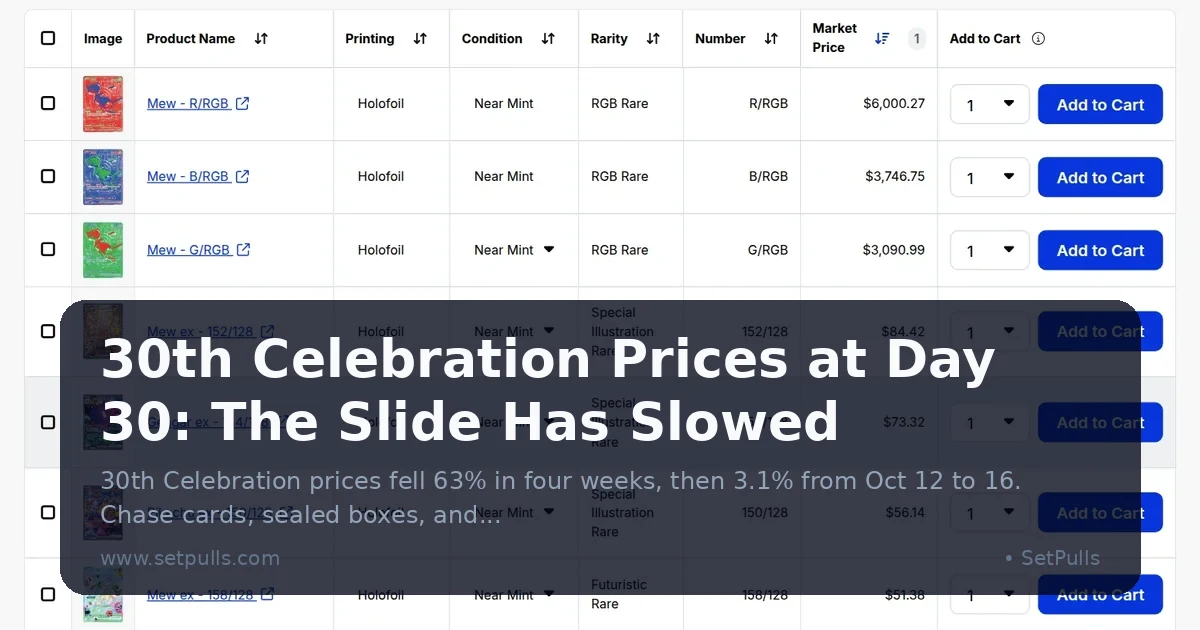
TickerMint’s read updated ~2026-10-19 locks the median: across the 22 priciest singles, median about −56% since the September 16 release; main-set chases such as Mew ex #152 ~$92, Gengar ex #154 ~$76, Pikachu ex #150 ~$62 (same direction as SetPulls’ October 16 read, slightly different timestamp). The priciest paper is not even on the ordinary SIR track — Mew #B/RGB ~$3,746.75 — another scarcity ledger that barely sits on the same table. What truly splits the script is the sealed contrast: Elite Trainer Box ~$128.97, 2.6× its $49.99 MSRP, about −18% since release; Pokémon Center ETB ~$297.39, 5.0×, about +12% since release; Booster Bundle ~$77.51, 2.9×, about −36% since release. Singles’ median halved; sealed still hangs on “if you can buy it, you win” premium.
The translation script says: money from old god-art flows into new god-art. The floor says: money leaves still-printing Ascended Heroes first, then finds anniversary SIRs also unsteady; the premium that remains sticks more to boxes than to every Special Illustration pulled. An attention vacuum is not “nobody plays Pokémon”; it is the myth narrative of the “greatest set” being sucked into a drop CSV inside the anniversary wave.
3. Split the ledgers: sealed scarcity and SIR chase are two books; an rising index cannot cover specific god-art falls
If you only watch Ascended Heroes’ Gengar and Treekachu, the story narrows to “one set failed.” Aim the camera at 30th Celebration’s ETB and main-set SIRs together, and autumn 2026 shows two ledgers running in parallel: one written by closed supply, channel quotas, Center boxes, and unreleased waves; one written by “god-art you can still pull” and “modern sets still being printed.”
ChaseCharts Week 42 (October 12–18) put the Pokémon index at about +1.2% over seven days and +5.5% over thirty. An index can rise without stopping specific modern SIRs from falling on TCGplayer’s drop table — the week’s gainers skew toward older promos, alternate arts, pre-2020s paper and event stamps, not “last week’s loudest anniversary SIR.” TCGplayer’s October 7 climbing report sharpens the counter: Southern Islands, Team Up secrets, WoTC-stamped Pikachu, BW promos climbing in a thirty-day window; the same season’s modern narrative fills the October 13 drop report with Ascended Heroes, Pitch Black, Perfect Order, and PRE reprints. On one side, “paper that cannot be printed again” keeps being revalued; on the other, god-art that is “still printing, shipping in waves, reprinted in September” gets named by the attention vacuum.

SetPulls’ sealed reads run with TickerMint: among seven sealed products they track, drops are generally smaller than singles’; unreleased waves even stay high. Their October 16 ETB read ~$132 still ~2.6× list; loose packs the same morning ~$12.56 — paying premium for the box, promo, and accessories is not paying premium for every SIR. Pull-rate talk further breaks the opening fantasy: in TCGplayer’s sample an SIR landed about 1 in 21 packs (most Mega Evolution sets ~1 in 80); at loose-pack averages, expected cost to hit a named SIR can sit around twenty times the card’s market. “Buy the single” and “open to chase god-art” no longer share one sentence of “anniversary is hot.”
The cruel honesty of two books is that they force you to stop merging holdings by set name. Ascended Heroes’ “greatest” is a checklist narrative; its price is a staggered-supply narrative. 30th Celebration’s “thirty years” is a brand narrative; its singles’ median −56% is an opening-supply narrative; its Center ETB at 5.0× is a channel-scarcity narrative. Crushing three sentences into one “Pokémon is up” or “Pokémon collapsed” is the cheapest market grammar; splitting them is how you see why Treekachu can fall out of a four-figure story while boxes stay dear.
4. Return: when “greatest” meets an attention vacuum, “value” must first ask whether supply is closed
What this move rewrites is not a cheap opposition like “never touch modern,” but where modern god-art sits on the timeline.
Once, a four-figure chase meant: loud openings, auction screenshots, social proof that “the set is worth it.” Now the timeline cuts twice more: is the set still shipping in waves and getting reprints? When anniversary or the next wave of attention arrives, will it drain remaining interest without catching singles? TCGplayer’s top drop slices, SetPulls’ Day-30 totals, TickerMint’s sealed multiples, ChaseCharts’ index-versus-name split — four lines point at one scene: Ascended Heroes’ myth written as a drop table; 30th Celebration’s attention enough to empty the neighbor, not enough to feed its own SIRs; sealed and singles are two books.
For anyone with a cart, the return should land on method, not chicken soup. Ask three questions first: are you buying a “closed-supply box,” or “god-art still being printed”? Is the gain you see an index / old promo / pre-2020 paper, or this week’s opened SIR? Has anniversary heat already written the old set’s attention vacuum as your opportunity cost? If those answers are muddy, do not treat “greatest set” as a charm, and do not treat an ETB’s 2.6× as floor proof for every Mew ex.
Method can be shorter: open TCGplayer’s September–October drop and climb reports, SetPulls’ Day-30 table, TickerMint’s products vs MSRP, then ask whether that card’s supply clock is still ticking. Answer clearly, and vacuum separates from scarcity; answer unclear, and percentages are only noise written another way.
Close: secondary-market “independence” means refusing to merge god-art and boxes under one “anniversary is hot”
Put Ascended Heroes’ autumn back into October 2026 Pokémon reality, and what it strikes is not collecting itself, but a quieter reading laziness — believing “greatest set” can resist staggered reprints; believing anniversary attention will translate old god-art money into new god-art; believing sealed premium and SIR medians can share one “Pokémon is hot”; believing a weekly index rise covers Gengar and Treekachu’s dollar drops.
Public data’s counterexamples are concrete: Mega Gengar ex ~$35.88 (about −$19.62 on the month); Treekachu ~$877.35 (about −$110.87); Dragonite ex ~$506 (~$500 Feb → ~$875 June → pullback); 30th’s 22 priciest singles median ~−56%; 158 numbered cards ~$1,885→~$673; ETB ~2.6×, Center ETB ~5.0×; Pokémon index ~+1.2% over seven days while specific modern SIRs can still fall on the drop table. Concrete, because it asks you to watch supply clocks and listings, not slogans and opening heat.
So “independence” can be redefined here. Independence need not mean shorting the anniversary or refusing modern; it can mean insisting, inside the same 30th Celebration wave, on split books: which prices belong to still-printing Ascended Heroes’ myth bankruptcy, which to anniversary SIR opening clearances, which to sealed-channel scarcity premium, which to the other ledger of old promos and closed-supply paper. Building a watchlist need not mean “buy every fallen god-art”; it can mean first writing which papers’ supply is already closed and which attentions are being vacuumed away, then deciding whether “greatest” is worth cash.
Executable prompts, short:
- Reading modern SIR prices, split “staggered/reprint supply” from “does anniversary attention catch the bid”; if you cannot restate both, treat the average as noise.
- Put sealed multiples (ETB, Center ETB, Bundle) and main-set SIR medians on two tables; a 2.6× box does not prove an $84 Mew ex is “still cheap.”
- Weekly index gains and monthly name drops can coexist; check ChaseCharts / trend gainers-losers for which book you are actually watching.
- “Greatest set” is checklist narrative, not price protection; Ascended Heroes’ lesson is that myth can be written into a drop CSV.
- If expected open cost is tens of times the single’s market, rewrite “chase god-art” as “buy the single” — heat and expected value are not the same word.
October anniversary boxes still swing between shelf and secondary; Ascended Heroes’ waves and reprints have not stopped the supply clock. For anyone staring at Treekachu and Mega Gengar, the art is still beautiful; what changed is that the secondary market is suddenly willing, after the “greatest” cheer passed, to write the attention vacuum as public dollar figures — because someone showed that anniversary heat can empty last year’s myth without holding new-myth singles in mid-air, and sealed scarcity and SIR chase were never the same book.

Sources and further reading
TCGplayer Seller Blog (2026-10-13): Price Trends: Pokémon Cards Dropping in Price - 10/13/2026
TCGplayer Seller Blog (2026-10-07): Price Trends: Pokémon Cards Climbing in Price - 10/07/2026
SetPulls (published 2026-10-17, reviewed ~10-16): 30th Celebration Prices at Day 30
TickerMint (updated ~2026-10-19): 30th Celebration prices
ChaseCharts Week 42 (2026-10-12–18): Week 42, 2026 card market report