

If the Pokémon secondary market in autumn 2026 still seemed willing to compress a whole sentence — “the index rose, sentiment climbed out of deeper fear, tracked market value cleared fourteen billion” — into a rising tide — Pokémon 200 at 2,911, about +5.0% in two weeks, only ~0.5% below its all-time high; sentiment up from 35 two weeks earlier to 39, still in Fear; tracked market value (now PSA+CGC+BGS) about $14.19B, roughly +8.2% over two weeks on a like-for-like basis — then TCGCharts’ *Market Pulse* for 16 October suddenly rewrote the grammar into something colder: the same table can hold “pre-2011 PSA 10 median about +36.7%” beside “2011-and-later PSA 10 median about −7.3%”; the same week can hold seven-figure *paid* Alt results for a 1st Edition Typhlosion and Charizard beside a Fanatics weekly auction whose $30.6M in bids had, by Friday, only about **17%** paid.
That sentence sounds like another round of “old cards up, new cards down.” What carries weight is not the word nostalgia, but the direction of the ledgers: money and eyesight do not lift the whole pool. They climb a low-population ladder — from grails to neighbors to reverse holos and e-Cards nobody used to watch — while writing modern PSA 10 medians into clearance and the most famous Pokémon’s graded market cap into near stillness. The image that runs through this piece is the **vertical**. Vertical is not the absence of noise; it is noise shooting up one axis while the axis beside it can stand still, or fall. The morning companion on Ascended Heroes and *30th Celebration* god-art wrote how modern SIRs can be vacuumed by anniversary heat without being caught; this afternoon piece is the complementary ledger — how vintage low-pops explode while Pikachu stands still.
I. Default myth: index near ATH + market-cap expansion = rising tide; a fortnight of data writes a rotation table
Industry default logic is clean, and therefore lazy.
A secondary narrative shouted as “Pokémon is hot again” almost always stares at the index, the sentiment dial, and total market value. This TCGCharts issue puts all three in the header — Pokémon 200 nearly back at its June record; Fear slightly less deep; tracked value on the new PSA+CGC+BGS basis reading about $14.19B. Lazy reading stops there and turns “half a percent from ATH” into a carnival.
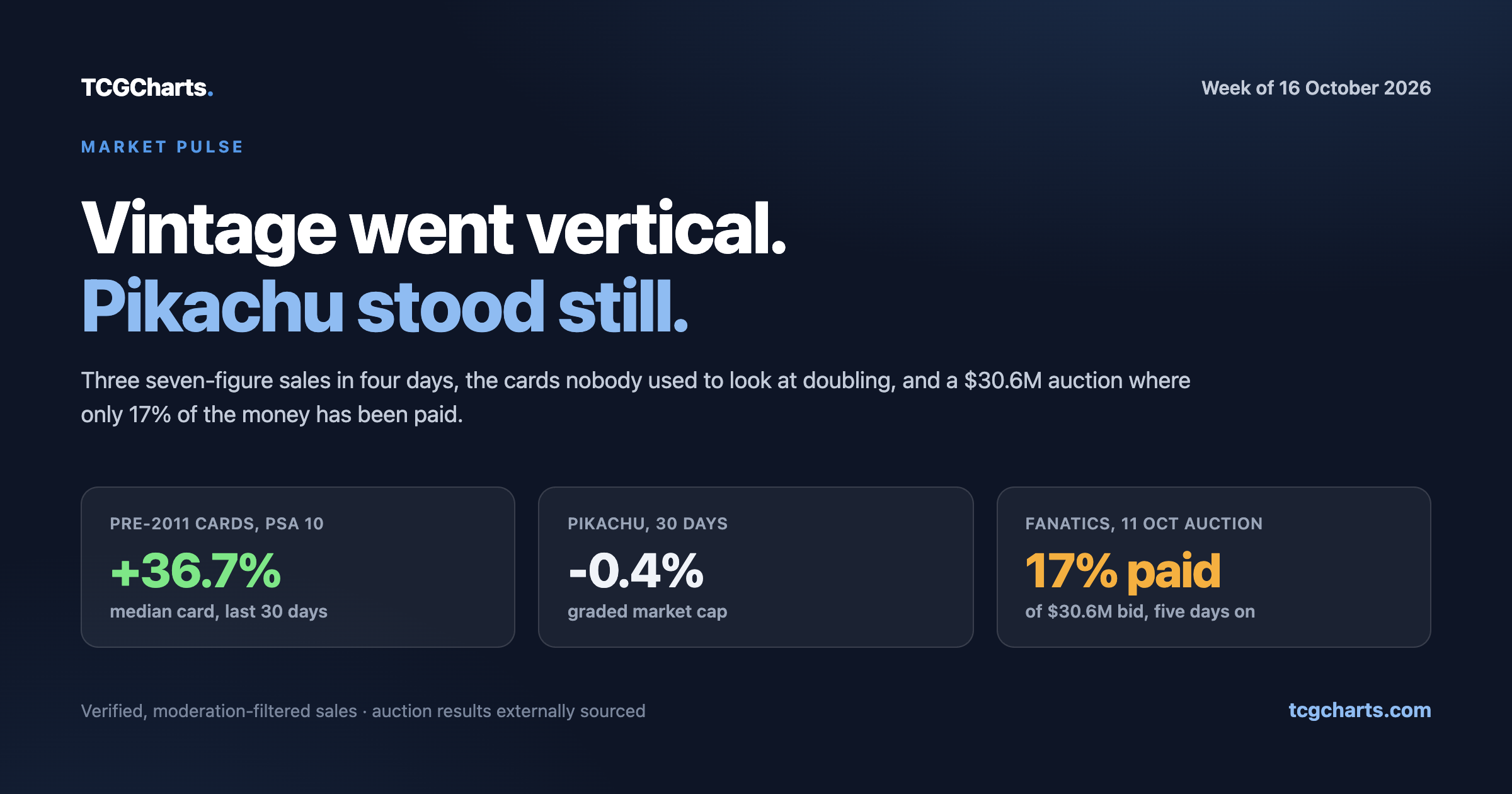
The next rows of the same table smash it open. Grail 25 at 2,505: about −0.6% over two weeks, −3.8% this week — because roughly two thirds of its weight is modern and about a third is Pikachu. Pre-2011 PSA 10s: last 30 days versus the prior 60, median about +36.7%, with ~90% of 307 cards higher. 2011-and-later PSA 10s: median about −7.3%, only ~30% of 1,215 cards higher. Mega Evolution-era PSA 10 median about −23.5%. Inside the index, the line is blunter: of 91 pre-2011 cards in Pokémon 200, 81 rose this month. An index can hug its all-time high while medians fork by print era into two slopes.
Default myth says: index up = the pool rises together. Populations and slabs say: the pre-2011 low-pop ladder is climbing vertically; the post-2011 PSA 10 median is walking down; Grail 25, weighted toward modern and Pikachu, cannot keep pace with Pokémon 200. The exception stings because it is not “one grail alone” — it is the next section: money has already reached the bottom rungs of the ladder, and auction hammers versus paid cash are still two books.
II. Smashing “only grails move”: the bid climbs down — Legendary / e-Card / Neo / Gold Star as breadth
If seven-figure screenshots still feel like headline weather, TCGCharts rewrites weather into climate: every boom has an order — grails first, then neighbors, then paper nobody watched. The data says vintage Pokémon has reached the last stage.
Legendary Collection reverse holos (2002, the “fireworks” pattern) are the clearest cut. Of 35 reverse holos with enough PSA 9 sales to measure, every one is higher than in the prior two months; median about +98%: Gyarados roughly $6,800→$19,550; Alakazam $3,000→$10,000; Meowth $1,600→$6,600; Beedrill $495→$1,800. At the top, two PSA 10 reverse holo Charizards hammered about $660k and $600k on Sunday, still awaiting payment — a year ago Fanatics sold one for about $35k.
e-Card holos: across 24 Expedition / Aquapolis / Skyridge holos with regular PSA 10 sales, every one rose; median about +125%. A Skyridge Umbreon PSA 10 (129 exist) went from about $65k in August to October sales at $142,655 and $150,000. Neo 1st Editions: at Fanatics, a Neo Revelation 1st Ed Raikou PSA 10 (37 exist) paid about $204k; a 1st Ed Houndoom (29) paid about $144k; across 13 Neo 1st Eds with regular PSA 10 sales, the median has more than tripled since summer. Gold Star Raikou PSA 10: about $14–16k in August, $30.9k by late September, then October at $64.1k / $69k / $70.1k — roughly 5× summer in two months.
Commentators will point to the 30th anniversary pulling a generation back to childhood paper and to how few top copies survived; TCGCharts adds the colder clause: populations this small move on very few new buyers, and one record reprices the whole band at once. On 8 October Alt wrote that clause in seven figures: Neo Genesis 1st Ed Typhlosion PSA 10 (only 13 exist) at $1,549,690 (June’s record had been $415,500); Base Set 1st Ed Charizard PSA 10 at $1,385,274, a public record above Goldin’s February $954,800. Both were paid results, not hanging hammers.
Breadth script says: only grails move. The floor says: the ladder has reached Meowth and Beedrill, e-Card and Neo 1st Ed medians, Gold Star fivefold in two months — and in the same week the modern PSA 10 median is still on a −7.3% slope.

III. Pikachu stood still: a character market cap need not ride the tide; Grey Felt Hat clears by the day
If the vintage ladder proves someone is paying real money, the Pikachu column proves “rising tide” is still too cheap a sentence.
On a graded basis, Pikachu’s character market cap sat near $2.14B, about −0.4% over 30 days. The board beside it moved: Charizard about $2.01B, +17.3%; Gengar about $691M, +37.8%; Lugia about +45.5%; Gyarados about +55.6%; Tyranitar about +54.4%. Charizard trails Pikachu by only about $133M and is gaining. Of 38 Pikachu cards in Pokémon 200, 27 fell this month — the value warehouse lives in modern promos, not in a fantasy that every character rises together.
The famous Grey Felt Hat (Van Gogh collab) PSA 10 drifted from about $2,800 in July into the low-to-mid $2,000s. It is not crashing; it is being graded out: PSA added about 740 more PSA 10s in two weeks alone; about 50,376 now exist; roughly fifty PSA 10 Grey Felt Hats enter per day. When it trades places with Base Set 1st Ed Charizard for the hobby’s single most valuable card by market cap — Charizard about $206M, Grey Felt Hat about $202M — the numbers can look close while the stories refuse to rhyme: one side is ~123 PSA 10s changing hands at six or seven figures; the other is 50,000+ PSA 10s hanging around a couple thousand dollars. If Alt’s $1.385M becomes the new Charizard level, that race will not stay tight.
On 11 October at Goldin, an Art Academy “Raincoat” Pikachu PSA 10 sold for about $1,037,000 including premium; fourteen days earlier at Fanatics the same card and grade went for about $8.4M — same paper, same grade, more than seven million apart in two weeks. TCGCharts’ reminder is short: for a card with a few dozen copies there is no market price, only the story of what one buyer paid one night; treat every number here as a story, not a valuation floor.
Pikachu standing still is not “nobody loves Pikachu”; it is modern promo supply still opening by the day while low-pop vintage money changed rooms. The modern SIR clearance in the morning companion and this column’s daily Grey Felt Hat adds are two hands on the same supply clock.
IV. Split ledgers: paid records versus unpaid hammers; remember 17%
If you only watch Alt’s Typhlosion and Charizard, the story narrows to “vintage invincible.” Point the camera at Fanatics’ 11 October weekly close and you see three books running in parallel in October 2026: paid frenzy in low-pop vintage; median clearance in modern PSA 10s; and the auction slice that has not yet become money.
Fanatics Collect that Sunday: 12,346 lots, about $30.6M bid. By Friday, buyers had paid for 7,665 lots — about 62% of lots — but only about $5.3M, **17%** of the money. Of 55 lots above $100k, five had been paid. Some 435 lots (about $18.2M, ~60% of bid dollars) cleared at more than 3× recent price — TCGCharts holds those out of prices until paid: paid counts; never paid never does. That is why their charts will not show a $660k Plasma Storm Lugia EX PSA 10 (guides often $4–5k) and will show the paid Raikou and Houndoom. Per its help center, Fanatics requires a credit card on file to bid as of 14 October.
Side notes, shorter: PSA’s backlog fell to about 8.2M on 6 October from about 9M on 22 September — clearing backlog means more modern slabs, not fewer; *30th Celebration* keeps restocking; Logan Paul plans a 29 October stream opening Legendary Collection sealed worth about $1.2M on camera — the very set whose reverse holos just doubled. Heat and the supply clock can share a frame; sharing a frame is not the same sentence as “rising tide.”
The cruel honesty of three books is that they force you to stop merging holdings by set name or character name. Alt’s seven figures are paid records; Fanatics’ 17% is hammer not yet cash; Pikachu’s −0.4% is modern promo population; pre-2011’s +36.7% is the low-pop ladder. Compressing four sentences into “Pokémon is up” or “auctions are fake” is the laziest market grammar; splitting them is how you understand why Typhlosion can print $1.55M while Grey Felt Hat is still graded into the two-thousands by the day.
Close: secondary-market “independence” means refusing to merge vertical and standing still under one “index is up”
Put TCGCharts’ mid-October back into autumn 2026 Pokémon and what it hits is not collecting itself, but a quieter reading laziness — assuming Pokémon 200 near ATH equals a universal tide; assuming seven-figure screenshots need no “was it paid?”; assuming Pikachu’s character cap will automatically follow the vintage ladder; assuming sentiment still in Fear cancels vertical frenzy.
Public data’s counterexamples are specific: pre-2011 PSA 10 median about +36.7% (~90% of 307 higher); 2011+ about −7.3%; Mega Evolution about −23.5%; Pokémon 200 about +5.0% while Grail 25 about −3.8% this week; Pikachu graded cap about −0.4%, Grey Felt Hat PSA 10s ~50/day, ~50,376 extant; Alt Typhlosion about $1.5497M and 1st Ed Charizard about $1.385M paid; Fanatics weekly about $30.6M bid, ~17% paid by Friday. Specific, because it asks you to watch population, payment, and print era — not only index headlines and auction thumbnails.
So “independence” can be redefined here. Independence need not mean shorting nostalgia or refusing modern; it can mean insisting, inside one Market Pulse, on split books: which prices belong to paid vertical on the low-pop ladder, which to median clearance in modern and Mega-era PSA 10s, which to Pikachu’s modern-promo supply ceiling, which to hammers above 3× recent price that have not paid. Building a watchlist need not mean “buy every vertical vintage”; it can mean first writing which sales cleared cash, which characters warehouse value in modern supply, which index weights are really Pikachu and modern — then deciding whether an unpaid hammer deserves to rewrite your ask.
Executable prompts, short:
- Hearing “Pokémon is up,” split pre-2011 / 2011+ / Mega medians; if you cannot restate all three, treat the index as noise.
- Ask of every record price whether it was paid; this fortnight’s Fanatics reminder word is **17%**.
- Put Pikachu character cap and Grey Felt Hat daily population on two columns; −0.4% is not lovelessness — the supply clock is still running.
- Separate ladder breadth (Legendary reverse, e-Card, Neo, Gold Star) from headline grails; Meowth $1,600→$6,600 and Typhlosion $1.55M are different rungs of the same vertical.
- Morning’s modern SIR vacuum and this piece’s vintage vertical are complementary ledgers — do not merge them under one “30th is hot.”
October’s sealed streams and anniversary restocks still swing on the calendar; PSA is still digging out backlog. For anyone staring at 1st Ed Charizard and Grey Felt Hat, the art is still beautiful; what changed is that the secondary market is suddenly willing, beside cheers that the index is almost at a high, to write vertical nostalgia and a standing-still Pikachu as two public columns — because someone showed that low-pop frenzy can clear seven figures in cash, that auction hammers can land at only seventeen percent paid, and that the most famous character’s market cap can barely move inside a rising-tide story.
